Table of Contents
BIS ISI Mark Certification for Tin Ingot - IS 26:2024 | A Complete Guide
Tin Ingots are widely used in the production of solders, chemicals, coatings, tin plating, and many electrical and electronic applications. As tin is a critical material in multiple industries, its purity and quality must be ensured through strict regulation.
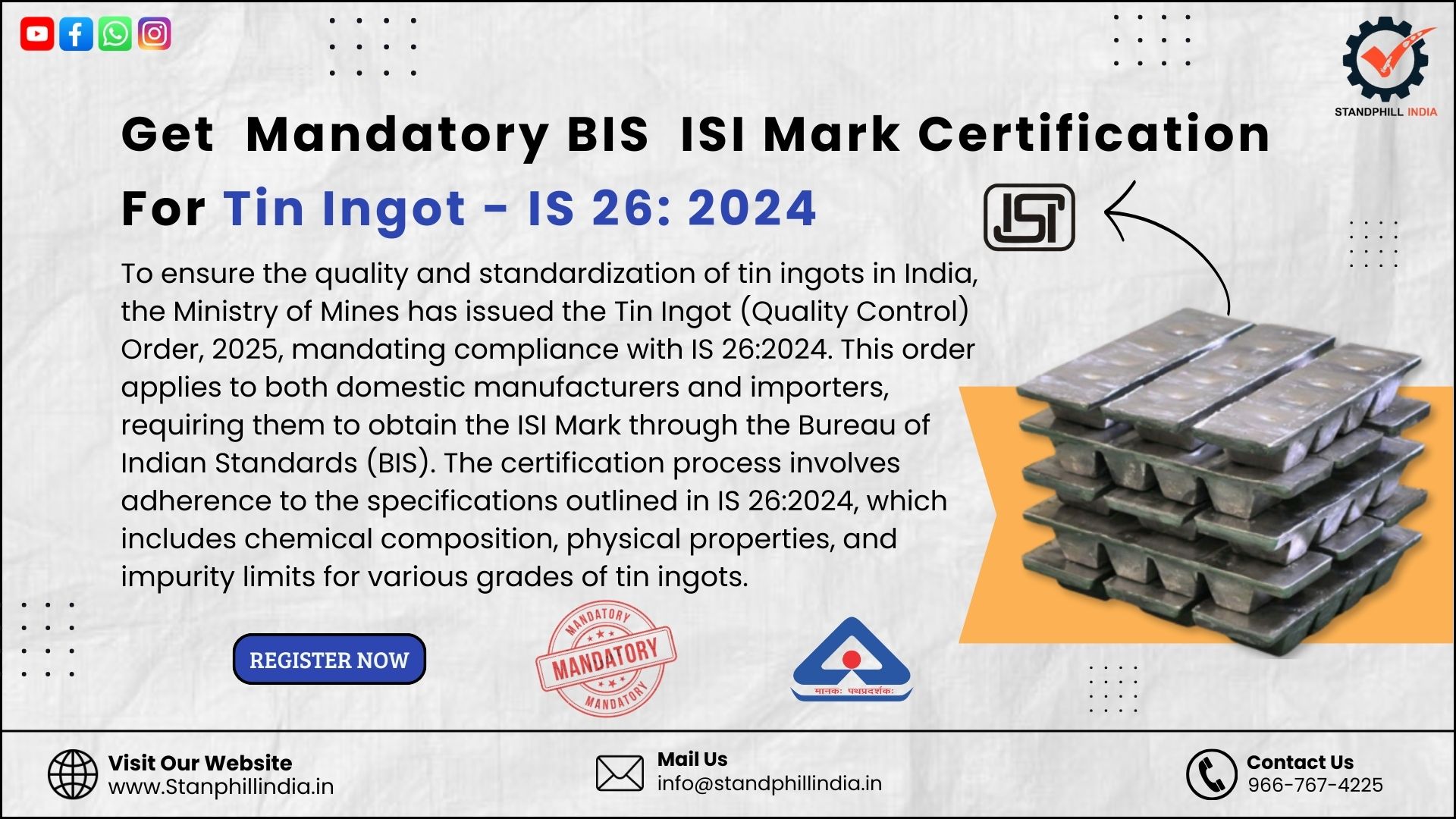
To maintain product safety and uniformity across the Indian market, the Bureau of Indian Standards (BIS) has made it mandatory to obtain ISI Mark Certification for Tin Ingots under the Indian Standard IS 26:2024.
In this blog, we’ll explain everything you need to know about BIS certification for tin ingots, including the certification process, standard requirements, documents, and how to apply.
Applicable Indian Standard for Tin Ingots
| Standard Number | IS 26:2024 |
| Product | Tin Ingot |
| Certification Scheme | ISI Mark (Scheme-I of BIS Conformity Assessment) |
| Authority | Bureau of Indian Standards (BIS) |
| Compliance | Mandatory under Quality Control Order (QCO) |
Why is BIS Certification Required for Tin Ingots?
The Ministry of Mines, in consultation with BIS, has issued a Quality Control Order (QCO) making BIS certification compulsory for tin ingots. This requirement helps prevent the use of low-quality or impure tin, ensures safety and consistency in industrial processes, supports environment-friendly practices, meets both domestic and export standards, and helps businesses avoid legal penalties for non-compliance. As a result, no tin ingots can be manufactured, sold, or imported in India without obtaining BIS ISI certification.
ISI Marking and Labeling
Each BIS-certified tin ingot must carry the ISI mark, which includes the ISI logo, the applicable standard number (IS 26:2024), the manufacturer's name or trademark, the batch number and weight, and the BIS license number (CM/L-xxxxxxx). The presence of this mark confirms that the product complies with the prescribed Indian Standard and meets all national quality requirements.
BIS Certification Process for Tin Ingots
The BIS certification process follows these steps:
1. Application Submission
Submit your application on the BIS Manakonline portal with factory and product details.
2. Sample Testing
Send tin ingot samples to a BIS-approved lab for testing as per IS 26:2024.
3. Factory Audit
BIS officers will inspect the production facility to check manufacturing quality, process flow, and in-house testing.
4. Grant of License
If all requirements are met, BIS issues the license to use the ISI mark on your tin ingots.
5. Surveillance & Renewal
BIS conducts periodic audits after certification to ensure continued compliance.
For Foreign Manufacturers
Foreign manufacturers must apply for certification under the Foreign Manufacturers Certification Scheme (FMCS). The certification process includes appointing an Authorized Indian Representative (AIR), sending product samples to BIS-approved laboratories in India for testing, and undergoing a factory audit conducted by BIS officers. Once certification is granted, manufacturers are required to use the ISI mark on their products before exporting them to India.
Documents Required
1. Company registration certificate
2. Manufacturing process and equipment details
3. In-house test reports (if available)
4. Packaging and labeling sample
5. Trademark authorization (if applicable)
6. Identity proof of authorized signatory
7. Quality control flowchart
Estimated BIS Certification Cost
| Component | Estimated Cost (INR) |
| Application Fee | 1,000 |
| Sample Testing Fee | 25,000 – 50,000 |
| Factory Audit Fee | 7,000 – 15,000 |
| Annual License Fee | 1,000 |
| ISI Marking Fee | Based on production volume |
Actual costs may vary depending on production capacity, factory location, and testing requirements.
How Standphill India Can Help
The BIS certification process can be complex and time-consuming, especially for new or international manufacturers. Standphill India simplifies the entire process by providing full documentation and application support, coordinating with BIS-approved laboratories for product testing, assisting with factory audit preparation, offering end-to-end guidance under the Foreign Manufacturers Certification Scheme (FMCS), and providing ongoing compliance tracking and post-certification support.
Conclusion
Getting BIS certification for Tin Ingots under IS 26:2024 is now a legal requirement for selling or importing in India. It also helps businesses gain trust, improve quality, and expand into new markets.
Don’t risk penalties - get BIS certified with expert support from Standphill India and grow your business the right way.
For More Blogs Click Here
- BIS Certification for Palm Fatty Acids
- BIS ISI Mark Certification for Hinges
- BIS Certification for Toys
- BIS Certification for Flashlights
- BIS ISI Mark Certification for Acetic Acid
- BIS Certification for Methanol
- BIS Certification for Digital Television Receiver for Satellite Broadcast Transmission
Need BIS Certification Support?
Our experts can help you with documentation, testing, application filing and complete BIS approval process.