
Table of Contents
Ordinary Portland Cement (OPC) is the foundation material of India’s construction sector. From residential buildings to large infrastructure projects, OPC remains the most commonly specified cement due to its predictable strength development, versatility, and widespread availability.
In India, the manufacture, sale, and import of Ordinary Portland Cement are strictly regulated by the Bureau of Indian Standards (BIS) under IS 269. As per the Cement (Quality Control) Order, 2003, Ordinary Portland Cement cannot be legally placed on the market without a valid BIS (ISI Mark) license.
At Standphill India, we provide expert guidance and end-to-end support for manufacturers navigating the BIS certification process for Ordinary Portland Cement, ensuring compliance with IS 269.
What is IS 269?
IS 269 is the Indian Standard that specifies requirements for Ordinary Portland Cement, including:
i. ) Chemical composition limits
ii. ) Physical and mechanical properties
iii. ) Strength requirements
iv. ) Quality control and testing methods
The standard ensures that Ordinary Portland Cement used across India delivers consistent performance, structural safety, and durability.
Regulatory Status: Mandatory BIS Certification
Ordinary Portland Cement falls under the Cement (Quality Control) Order, 2003. Accordingly:
i. ) BIS certification is mandatory
ii. ) Cement must bear a valid ISI Mark
iii. ) Non-certified Ordinary Portland Cement is prohibited for manufacture, sale, or import
iv. ) Failure to comply constitutes a statutory violation.
Purpose of BIS Certification for Ordinary Portland Cement
BIS certification under IS 269 is intended to:
i. ) Protect consumers from substandard cement
ii. ) Ensure uniform strength and performance
iii. ) Maintain national construction quality benchmarks
iv. ) Enable regulatory traceability and accountability
For infrastructure and government projects, ISI-marked Ordinary Portland Cement is a non-negotiable requirement.
Technical Scope of IS 269
Composition Control
IS 269 prescribes limits on:
i. ) Lime saturation
ii. ) Magnesia content
iii. ) Sulphur trioxide (SO?)
iv. ) Loss on ignition
These controls directly influence strength, soundness, and durability.
Physical & Mechanical Properties
Ordinary Portland Cement must meet requirements for:
i. ) Fineness
ii. ) Setting time (initial and final)
iii. ) Soundness
iv. ) Compressive strength at specified curing ages
Grades of Ordinary Portland Cement
Historically, Ordinary Portland Cement has been supplied in different strength grades. IS 269 governs general-purpose Ordinary Portland Cement, ensuring compliance with minimum strength and performance criteria applicable across construction segments.
Applications of IS 269 Cement
Ordinary Portland Cement is commonly used in:
i. ) Residential and commercial buildings
ii. ) Reinforced cement concrete (RCC) works
iii. ) Precast concrete products
iv. ) Roads and pavements
v. ) Bridges and flyovers
vi. ) Industrial and institutional buildings
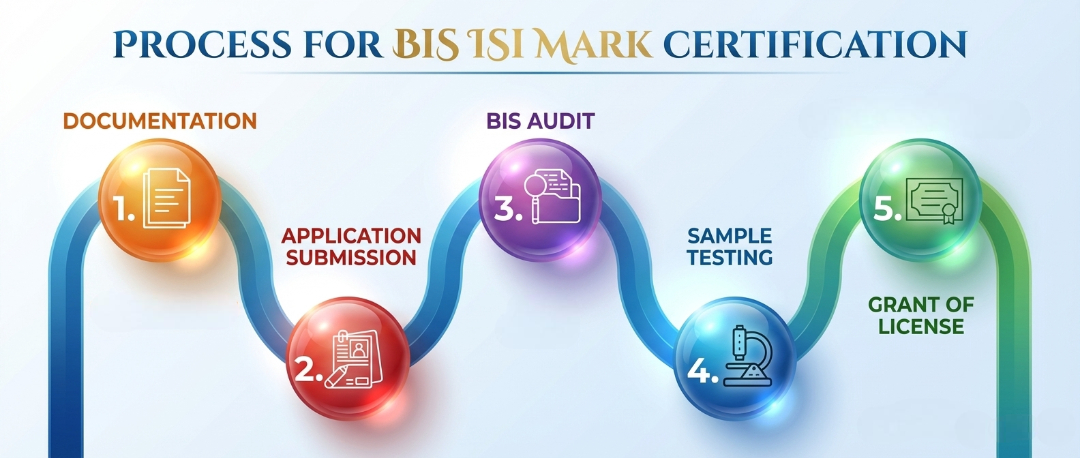
BIS Certification Process for Ordinary Portland Cement
The BIS certification process under IS 269 involves:
1. ) Identification of IS 269 as applicable standard
2. ) Preparation of technical and quality documentation
3. ) Online BIS application submission
4. ) Factory inspection by BIS officials
5. ) Sampling of cement for independent testing
6. ) Testing at BIS-recognized laboratories
7. ) Grant of BIS license with ISI Mark permission
8. ) Ongoing surveillance and compliance audits
Documentation Required
Manufacturers are required to submit:
i. ) Company incorporation and factory registration documents
ii. ) Manufacturing process flow diagram
iii. ) Plant layout and machinery details
iv. ) In-house laboratory facilities
v. ) Quality control system documentation
vi. ) Raw material and clinker test reports
vii. ) Trademark and authorization documents
BIS Certification Fees and Cost for IS 269 Cement
For Indian Manufacturers
| No. | Major Charges | Particulars | Amount | Remark |
|---|---|---|---|---|
| 1. | BIS Fee | Application Fees | INR 1000 | To be paid in BIS A/c directly. 20% rebate on Marking Fee for MSME units. |
| Audit Charges | INR 7000 | |||
| License Fee | INR 1000 | |||
| Marking Fee | INR 72,000 | |||
| 2. | Testing Charges | Sample Test Fee | As Applicable | To be paid into BIS approved Lab A/c |
| 3. | Standphill India Service Fee | Consultancy & others | As per actual | (Depending upon the product and the region of factory) |
For Foreign Manufacturers
| No. | Major Charges | Particulars | Amount | Remark |
|---|---|---|---|---|
| 1. | BIS Fee | Application Fees | USD 30 | To be paid into BIS A/c directly in USD (SWIFT). SAARC countries can pay in INR with GST@18% |
| Audit Charges (consolidated) | USD 3200 to USD 5900 | |||
| License Fee | USD 30 | |||
| Marking Fee | USD 1000 | |||
| 2. | Testing Charges | Sample Test Fee | As applicable | To be paid into BIS approved Lab A/c |
| 3. | Standphill India Service Fee | Consultancy & other charges | As per actual | (Depending upon the product and the location of mfg.) |
Actual cost depends on plant capacity and compliance preparedness.
Who Must Obtain BIS Certification?
BIS certification under IS 269 is mandatory for:
i. ) Indian manufacturers of Ordinary Portland Cement
ii. ) Foreign manufacturers exporting Ordinary Portland Cement to India
iii. ) Brand owners marketing Ordinary Portland Cement under their name
iv. ) Dealers and distributors must ensure that only ISI-marked Ordinary Portland Cement is traded.
Consequences of Non-Compliance
Non-compliance with IS 269 and BIS regulations may result in:
i. ) Monetary penalties
ii. ) Seizure of non-conforming cement
iii. ) Suspension or cancellation of manufacturing operations
iv. ) Legal action under the BIS Act
Business & Compliance Benefits of BIS Certification
Holding a BIS license for Ordinary Portland Cement enables:
i. ) Legal market access across India
ii. ) Eligibility for government and infrastructure tenders
iii. ) Higher acceptance among engineers and consultants
iv. ) Reduced compliance and litigation risk
v. ) Strengthened brand credibility
Role of a BIS Consultant: Is It Mandatory?
Engaging a BIS consultant is not mandatory, but Ordinary Portland Cement certification involves complex documentation, inspections, and technical evaluations. Without expert support, manufacturers often face delays, non-conformities, or rejection.
Why Choose Standphill India for BIS Certification of Ordinary Portland Cement?
Standphill India provides specialized BIS certification consultancy for cement manufacturers, including:
i. ) Gap analysis against IS 269 requirements
ii. ) Documentation preparation and verification
iii. ) Pre-inspection readiness audits
iv. ) Assistance during BIS factory inspection
v. ) Coordination of laboratory testing
vi. ) Post-certification compliance and renewal support
Conclusion
Ordinary Portland Cement governed by IS 269 remains a critical construction material in India. Given its regulatory importance and widespread application, BIS (ISI Mark) certification is compulsory. Manufacturers seeking uninterrupted market access and long-term compliance must adhere strictly to IS 269 requirements and obtain a valid BIS license.
Get in touch with Standphill India today and secure your BIS certification for Ordinary Portland Cement (IS 269) hassle-free!
Need BIS Certification Support?
Our experts can help you with documentation, testing, application filing and complete BIS approval process.