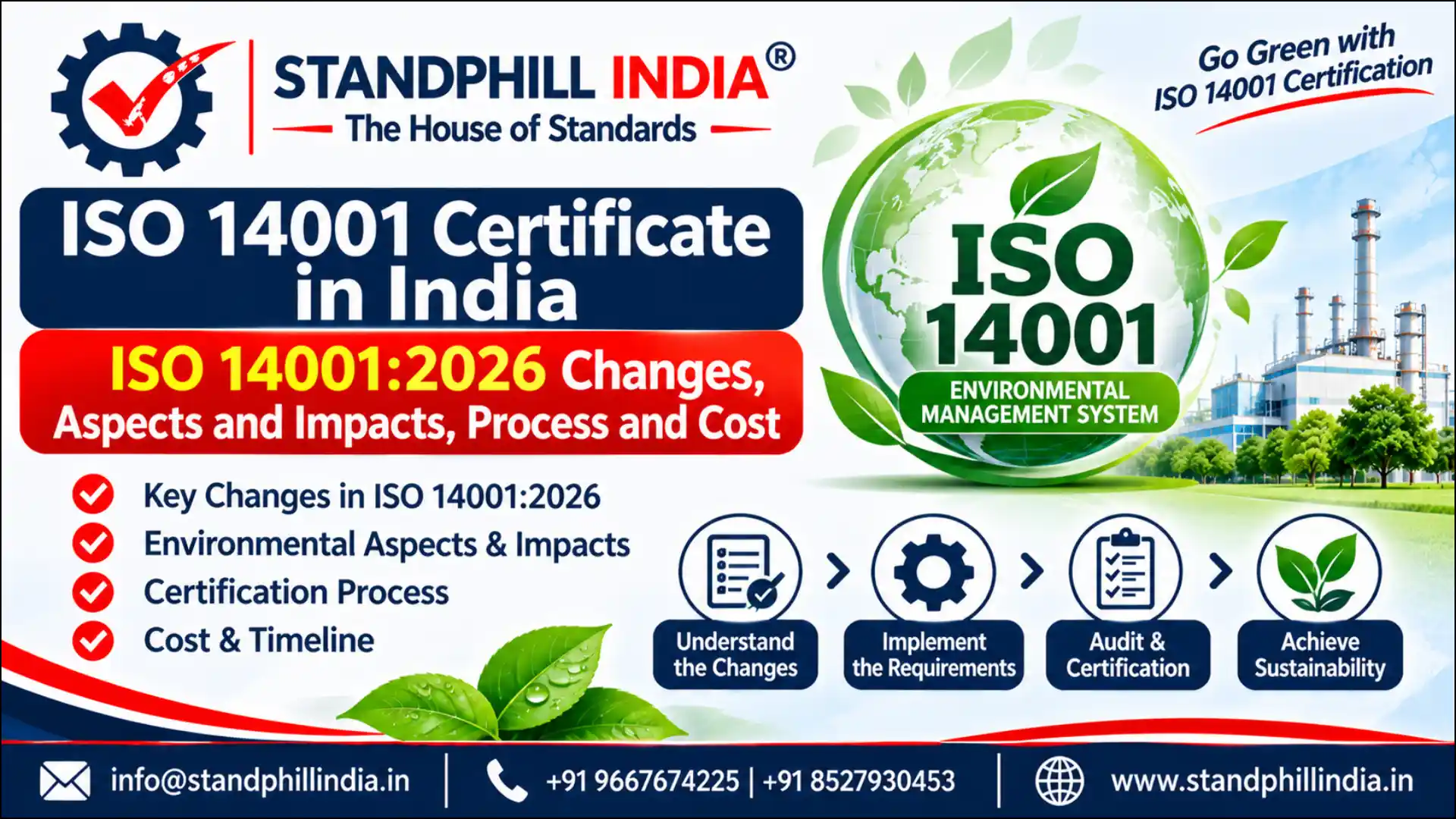
ISO 14001 Certificate in India: the 2026 Edition and What It Asks of Your Site
ISO 14001:2026 now names pollution, natural resources, climate change, biodiversity and ecosystem health as context issues - and adds a new clause on planning changes
ISO 14001 is the international standard for an environmental management system. It requires an organisation to identify how its activities interact with the environment, decide which of those interactions matter, keep track of the environmental law that applies to it, set objectives, control its operations and demonstrate improvement. The current edition is ISO 14001:2026, published in April 2026 as the fourth edition, replacing ISO 14001:2015 and its 2024 climate amendment. The headline change is that Clause 4.1 now names the environmental conditions you must consider - pollution levels, availability of natural resources, climate change, biodiversity and ecosystem health - and a new Clause 6.3 requires changes to be planned. ISO 14001 is voluntary and is not a substitute for a Consent to Operate from a State Pollution Control Board or any other statutory environmental approval.
ISO 14001 - Key Facts
- Full title: ISO 14001 - Environmental management systems - Requirements with guidance for use.
- Current edition: ISO 14001:2026, published April 2026, the fourth edition.
- Replaces: ISO 14001:2015 and ISO 14001:2015/Amd 1:2024.
- Edition history: 1996, 2004, 2015, 2026.
- Transition: approximately three years from publication, pointing to about 30 April 2029. The standard itself sets no deadline - the date comes from the accreditation forum and your certification body.
- Legal status: voluntary. It does not replace Consent to Establish, Consent to Operate, Environmental Clearance or any authorisation under Indian environmental law.
- Defining feature: the environmental aspects and impacts register, and the register of compliance obligations.
- Validity: three years, with surveillance audits in years one and two.
- Commonly required with: ISO 9001 and ISO 45001 in construction, infrastructure and works tenders.
- What ISO 14001 Requires
- ISO 14001:2026 - What Changed from ISO 14001:2015
- The Transition from ISO 14001:2015
- Environmental Aspects and Impacts: the Heart of the Standard
- The Life Cycle Perspective
- Compliance Obligations Under Indian Environmental Law
- ISO 14001 Is Not a Consent to Operate
- Who Needs ISO 14001
- What the Environmental Management System Must Contain
- The ISO 14001 Certificate Process
- Running ISO 14001 With ISO 9001 and ISO 45001
- What ISO 14001 Certificate Costs
- Mistakes That Produce Audit Findings
- How Standphill India Helps
- Frequently Asked Questions
What ISO 14001 Requires
ISO 14001 does not set emission limits, prescribe technology or define what counts as acceptable pollution. It requires an organisation to work out for itself how it affects the environment, identify the law that binds it, decide what to do about both, and prove that it did it.

That self-determining character is what people find disorienting when they first read the standard. A manufacturer expects a number - a permitted level of effluent, a maximum stack concentration. The standard gives none. Those numbers come from statute and from the conditions on your consents. What ISO 14001 adds is the management discipline around them: knowing which obligations apply, controlling the operations that could breach them, measuring whether you are complying, and reacting when you are not.
In practice the standard produces three artefacts that an auditor will always ask for, and that most organisations do not possess before certification:
Every way your activities, products and services interact with the environment, the impact each interaction causes, and a documented judgement of which are significant.
Every legal requirement and other obligation that applies to you, mapped to the operation it governs, with evidence that you periodically evaluate whether you are complying.
Identified potential emergency situations with environmental consequences, planned responses, and periodic testing of those responses.
Everything else in the standard - objectives, operational controls, competence, monitoring, internal audit, management review - follows from these. Build the three properly and the rest falls into place. Buy them as templates and the system has no foundation, because they are the only parts of ISO 14001 that cannot be generic: another company's environmental aspects are not yours.
ISO 14001:2026 - What Changed from ISO 14001:2015
The core structure and the Plan-Do-Check-Act model are unchanged. The substantive changes are concentrated in four places: Clause 4.1 now names the environmental conditions you must consider, a new Clause 6.3 requires planning of changes, the treatment of environmental aspects is strengthened, and the controls over externally provided processes and the life cycle are broadened.
ISO 14001:2026, the fourth edition, replaces ISO 14001:2015 and its 2024 climate amendment
The Draft International Standard circulated through 2025, the Final Draft was released on 5 January 2026, and the fourth edition was published in April 2026. It is the first substantial revision of ISO 14001 in eleven years, and it absorbs Amendment 1:2024, which had added climate change considerations to Clauses 4.1 and 4.2 in February 2024.
Sources: ISO 14001:2026 publication record, fourth edition, April 2026, cancelling and replacing ISO 14001:2015 and ISO 14001:2015/Amd 1:2024; FDIS released 5 January 2026; Amendment 1:2024 on climate action, February 2024.
| Clause | What changed | What you actually have to do |
|---|---|---|
| 4.1 | The biggest change for most certified sites. The environmental conditions to be considered in your context analysis are now named: pollution levels, availability of natural resources, climate change, biodiversity and ecosystem health. The 2015 edition mentioned environmental conditions in general and listed examples only in the informative annex | Revisit your context analysis and record a considered position on each named condition - how it affects you and how you affect it. "Not applicable" is an acceptable conclusion where it is true and reasoned; a blank is not |
| 4.2 | Interested parties' expectations now explicitly include climate-related requirements | Record which interested-party requirements you have chosen to address, climate-related ones included |
| 6.1 | Risks and opportunities handling is tightened, with the environmental aspects determination strengthened and conditions of operation - normal, abnormal and emergency, and change - more clearly required | Your aspects register must distinguish normal operation from abnormal and emergency conditions, and must be revisited when something changes |
| 6.3 | New clause: planning of changes. ISO 14001 now carries the dedicated change-planning clause common to the Harmonized Structure | Build or extend a change-management procedure covering new production methods, site changes, new equipment, new materials and changed regulatory requirements - including who is informed and how effectiveness is reviewed |
| 8.1 | Expanded requirements for externally provided processes, products and services, and for the life cycle perspective | Push your environmental requirements into procurement and contractor control, and be able to show you considered the stages of the life cycle you can influence |
| 7.5 | Documented information requirements standardised to the Harmonized Structure wording | Nothing substantive. Update references |
| Annex A | Substantially expanded guidance on the intent of the requirements | Read it before arguing with an auditor about significance criteria or the life cycle perspective |
If you read only one thing about the 2026 edition: the named environmental conditions in Clause 4.1 move biodiversity and resource availability from "nice to mention" into the requirements text. A context analysis that discusses only effluent, emissions and waste is now incomplete for most industrial sites.
The Transition from ISO 14001:2015
ISO 14001:2026 contains no transition deadline of its own. Its foreword states only that it cancels and replaces the 2015 edition and the 2024 amendment. The dates come from the International Accreditation Forum and are applied by accreditation bodies and certification bodies, and published guidance points to a three-year window ending around 30 April 2029.
| Milestone | What it means |
|---|---|
| April 2026 | ISO 14001:2026 published. ISO 14001:2015 and its 2024 amendment are withdrawn as standards, although certificates against them remain valid through the transition |
| From mid-2026 | Certification bodies complete their own accreditation to audit against the fourth edition. Transition audits become available |
| 2027 to 2028 | The bulk of transitions take place at scheduled surveillance and recertification audits. Guidance from several bodies indicates that recertification audits from late 2027 will incorporate transition requirements |
| Around 30 April 2029 | Reported transition deadline, after which ISO 14001:2015 certificates cease to be valid. Confirm the exact date with your certification body |
The practical sequence is short, and there is no reason to defer it. Run a gap review against the four substantive changes. Rebuild the Clause 4.1 context analysis around the five named environmental conditions. Add or extend a change-planning procedure for Clause 6.3. Extend your aspects register to distinguish normal, abnormal and emergency conditions. Push environmental requirements into procurement and contractor documents. Then transition at your next scheduled audit rather than paying for a separate visit.
For the current edition of every standard in this cluster, and how transition deadlines are set, see the current-editions table on our ISO certification hub.
Environmental Aspects and Impacts: the Heart of the Standard
An aspect is an element of your activities, products or services that can interact with the environment. An impact is the change to the environment that results. Getting this register right is the difference between a working environmental management system and a folder.
The vocabulary trips people up, so a worked example is more useful than a definition. Below is the shape of a register for a metal fabrication unit - not a template to copy, but an illustration of the logic an auditor follows.
| Activity | Aspect | Impact | Condition | Significant? |
|---|---|---|---|---|
| Degreasing and pre-treatment | Discharge of spent chemical bath | Contamination of water and soil | Normal | Yes - legal limits apply, high severity |
| Welding | Fume and particulate emission | Air quality deterioration | Normal | Yes - consent condition applies |
| Powder coating oven | Natural gas and electricity consumption | Resource depletion, greenhouse gas emissions | Normal | Yes - climate change is a named condition in the 2026 edition |
| Metal cutting | Generation of metal scrap | Resource consumption; diverted by recycling | Normal | No - fully recycled, low severity |
| Oil storage | Potential spill from drum handling | Soil and groundwater contamination | Emergency | Yes - low likelihood, high severity |
| Effluent treatment plant | Discharge exceeding limits during plant failure | Water pollution, consent breach | Abnormal | Yes - regulatory consequence |
| Office operations | Paper consumption | Resource consumption | Normal | No - low magnitude |
| Finished goods packaging | Plastic packaging entering the waste stream | Plastic waste; extended producer responsibility applies | Normal | Yes - compliance obligation under the Plastic Waste Management Rules |
How Significance Is Decided
The standard requires you to determine significance using criteria you establish, and then to be consistent. There is no prescribed method, but every method that survives audit does three things: it is written down, it is applied to every aspect, and it produces the answer that common sense would produce. Criteria in general use include:
- Legal consequence - whether a statutory limit, consent condition or authorisation governs the aspect. In practice this alone makes an aspect significant.
- Severity of the impact if it occurs, and whether it is reversible.
- Likelihood or frequency - which is why abnormal and emergency conditions, rare but severe, usually come out significant.
- Scale and duration - how much, over how long, and over what area.
- Interested-party concern - a community complaint about noise or odour is evidence of significance even where no limit is breached.
A register in which nothing is significant is the clearest possible sign that the exercise was not done. A register in which everything is significant is equally unhelpful, because the objectives and operational controls that follow have to be proportionate to be real.
The Life Cycle Perspective
ISO 14001 requires you to consider the environmental aspects of the life cycle stages you can control or influence. It does not require a life cycle assessment, a carbon footprint study or any quantified analysis - a point the expanded Annex A of the 2026 edition makes explicitly, and one that saves a great deal of unnecessary expenditure.
The requirement is proportionate to your influence, and that is the key to satisfying it sensibly. A contract manufacturer making to a customer's drawing has little influence over design and should say so. A company that designs its own product has a great deal, and an auditor will expect to see evidence that environmental considerations entered the design process - material selection, reduction of packaging, energy consumption in use, ease of disassembly.
The 2026 edition strengthens the adjacent requirement in Clause 8.1 on externally provided processes, products and services. In practice this is where most of the audit attention falls, because it is actionable: environmental requirements written into purchase specifications, contractor induction covering waste segregation and spill response, evaluation of waste contractors' authorisations, and checks that a hazardous-waste handler is genuinely authorised for the waste you are giving it.
Compliance Obligations Under Indian Environmental Law
The standard calls them compliance obligations: legal requirements an organisation must comply with, plus other requirements it chooses to comply with. For an Indian manufacturing site the legal list is longer than most firms realise before they build the register.
Consent to Establish and Consent to Operate from the State Pollution Control Board, with conditions on effluent quality, quantity and discharge point.
Consent under the Air Act, with conditions on stack emissions, monitoring frequency and ambient air quality.
The framework legislation under which most environmental rules are notified, including the standards your consents reference.
Authorisation for generation, storage and disposal, manifest system for transport, records of quantities, and use of authorised recyclers and treatment facilities.
Extended producer responsibility registration and targets for producers, importers and brand owners, with annual returns on the central portal.
EPR obligations for producers of listed electrical and electronic equipment, and authorised channels for the disposal of your own end-of-life IT equipment.
EPR for producers of batteries, with collection and recycling targets and portal filings.
Ambient noise limits by area category, and limits for DG sets and other equipment.
Under the EIA Notification for listed project categories and expansions, with compliance reporting against the clearance conditions.
Where they impose environmental and hazardous-process obligations alongside occupational ones.
Where applicable, from the Central Ground Water Authority or the State authority, with abstraction limits and recharge conditions.
Customer environmental codes, parent-company standards, industry codes and public commitments. Once adopted, the standard treats these as obligations and audits them.
Two requirements attach to this register and both are routinely under-served. First, you must keep it current - environmental rules in India are amended frequently, and a register last updated three years ago is a finding. Second, you must periodically evaluate compliance and retain the results. That means a documented check, at a stated frequency, that asks obligation by obligation whether you are actually complying - not a declaration that you are.
ISO 14001 Is Not a Consent to Operate
This has to be said plainly because the confusion is widespread and the consequences are serious. An ISO 14001 certificate gives you no legal permission to do anything. It does not substitute for Consent to Establish, Consent to Operate, hazardous waste authorisation, Environmental Clearance or EPR registration, and no Pollution Control Board accepts it in place of any of them.
A statutory environmental approval
Granted by a State Pollution Control Board, the CPCB or MoEFCC under an Act of Parliament. Site-specific, condition-bearing, time-limited, and enforceable by closure directions, prosecution and environmental compensation. Operating without one is an offence.
An ISO 14001 certificate
Granted by a private certification body against a voluntary international standard. Evidence that you manage environmental matters systematically. Valuable in tenders, with customers and as internal discipline - and of no legal effect whatsoever.
The relationship between them runs the other way round from what people assume. Your consents and authorisations are inputs to the ISO 14001 system: they populate the register of compliance obligations, their conditions become the operational controls you must maintain, and their monitoring requirements become your monitoring programme. A site whose consent has expired cannot be compliant with ISO 14001, because Clause 9.1.2 requires it to evaluate compliance with its legal obligations and it would fail that evaluation. An auditor who finds an expired consent will raise a nonconformity.
If a provider suggests that ISO 14001 will help with a pending consent application, or will satisfy a Board requirement, treat it as a reason to go elsewhere. The two processes are unrelated, and the only overlap is that a well-run environmental management system makes it easier to demonstrate compliance with the conditions you already hold.
Who Needs ISO 14001
The demand is driven by three things: tender conditions, customer requirements in export supply chains, and the practical difficulty of managing a growing set of environmental obligations without a system.
- Construction, infrastructure and works contractors. The most consistent source of demand in India. Works tenders routinely require ISO 9001, ISO 14001 and ISO 45001 together, and the three are usually certified as one integrated system.
- Manufacturers with significant environmental aspects. Chemicals, metals, textiles processing, electroplating, foundries, pharmaceuticals, cement, paper, tanneries - sectors where the obligations are heavy and a system pays for itself in avoided breaches.
- Exporters to the European Union and to large multinational buyers. Increasingly asked for at the supplier onboarding stage, often alongside questions about emissions reporting and supply chain due diligence.
- Companies facing supply chain environmental requirements. Automotive, electronics and retail supply chains push environmental conditions down to their suppliers, who inherit them contractually.
- Industrial estates and logistics parks whose tenants or lenders require it.
- Organisations under scrutiny - after a complaint, a show-cause notice or a community dispute, a certified system is a demonstrable change of practice rather than an assurance.
Where ISO 14001 adds least is an office-based business with negligible environmental aspects and no tender or customer requirement. A software firm can certify, and the system will be thin because the aspects are thin. If nobody is asking for it, the money is better spent elsewhere - and our ISO hub page sets out how to tell which standard, if any, your situation actually calls for.
What the Environmental Management System Must Contain
Beyond the three core registers, a Stage 2 audit will look for the following. The list is specific to ISO 14001 - the generic management system elements are covered in our ISO 9001 guide.
| Element | What it has to show |
|---|---|
| Scope of the EMS | The activities, products, services, sites and boundaries covered. Be careful with leased premises and shared facilities |
| Context analysis | Internal and external issues, including a reasoned position on each named environmental condition - pollution, natural resources, climate change, biodiversity, ecosystem health |
| Environmental policy | Signed by top management and committed to protection of the environment, fulfilment of compliance obligations and continual improvement |
| Aspects and impacts register | With documented significance criteria, covering normal, abnormal and emergency conditions, and the life cycle stages you can influence |
| Compliance obligations register | Current, mapped to operations, with records of periodic compliance evaluation |
| Environmental objectives and plans | Measurable, addressing the significant aspects and the compliance obligations, with resources, responsibility, timing and the method of evaluating results |
| Change planning records | New under Clause 6.3. How planned changes are assessed, communicated and reviewed |
| Operational controls | The controls over the significant aspects, including the conditions attached to your consents, and controls extended to contractors and suppliers |
| Emergency preparedness and response | Identified scenarios, response procedures, trained responders, and records of periodic testing. Spill drills are the usual evidence |
| Monitoring and measurement | What you measure, how, how often, and with what equipment - calibrated where it matters. Effluent and emission monitoring reports belong here |
| Competence and awareness records | Including awareness of the significant aspects relevant to each person's work and the consequences of departing from the controls |
| External communication records | Including communication with regulators, which the standard requires you to manage rather than leave to chance |
The ISO 14001 Certificate Process
Three to five months from a standing start - slightly longer than ISO 9001, because the aspects register and the compliance register take real work and because monitoring data takes time to accumulate.
Initial review
Aspects, obligations, consents
Build registers
Aspects, impacts, obligations
Controls and objectives
Proportionate to significance
Operate
Monitoring, drills, records
Internal audit
And compliance evaluation
Stage 1 and 2
Certification audits

The initial environmental review. Walk the site. List what comes in, what goes out and what could go wrong. Collect every consent, authorisation, clearance and registration you hold, with its expiry date. This step frequently surfaces an expired authorisation or an EPR registration nobody filed, which is uncomfortable but far better found now than by an auditor or an inspector.
Building the registers. The aspects register and the compliance obligations register, with significance criteria written down and applied consistently. Expect this to take two to four weeks for a manufacturing site, and expect it to be the most valuable part of the exercise.
Controls and objectives. Operational controls over the significant aspects, emergency arrangements for the emergency-condition aspects, and objectives that address the significant aspects and the obligations. Objectives should be ones you intend to achieve; an objective invented for the audit will be measured at the next audit.
Operating the system. Monitoring to the frequency you have set, a tested emergency drill, waste records, a documented compliance evaluation. Three months of real operation is a sensible minimum, and the compliance evaluation in particular cannot be produced retrospectively.
Internal audit and management review, then Stage 1 - documentation, scope and readiness - and Stage 2 on site. Environmental auditors spend their time at the effluent treatment plant, the hazardous waste store, the DG set, the stack monitoring records and the consent conditions. Prepare those rather than the manual.
The certificate runs for three years with surveillance audits in years one and two and recertification in year three.
Before you choose a certification body: Check the certification body's accredited scope before you sign. Accreditation is granted standard by standard and, for environmental management, accreditation bodies also look at the technical sectors a body may audit - so confirm that ISO 14001 and your industry sector both fall inside the scope listed in the NABCB directory or that of another IAF-recognised accreditation body. Our guide to ISO certification in India explains the accreditation chain, the cost structure and how to verify a certificate.
Running ISO 14001 With ISO 9001 and ISO 45001
If a tender asks for all three - and works tenders usually do - certify them as one integrated management system and have them audited together. It is cheaper, and it produces a system people can actually use.
The standards share the Harmonized Structure: common clause titles, core text and definitions. In practice this means a single set of arrangements can serve all three, with only the technical content differing:
| Element | Shared across the three | Standard-specific |
|---|---|---|
| Context and interested parties | One analysis, one register | Environmental conditions are specific to 14001; worker-related parties to 45001 |
| Policy | A combined policy is acceptable | Each standard's required commitments must appear |
| Risk and opportunity | One process and register | Environmental aspects for 14001; hazards and OH&S risks for 45001; quality risks for 9001 |
| Legal and other requirements | One register, one evaluation routine | Environmental law for 14001; occupational law for 45001 |
| Competence, awareness, communication | One framework | Content differs by subject |
| Documented information control | One system | None |
| Internal audit | One programme, one audit team, combined reports | Checklists differ |
| Management review | One meeting, covering all three sets of inputs | Inputs differ by standard |
| Nonconformity and corrective action | One process and log | 45001 additionally requires incident investigation |
An integrated audit takes fewer days than three separate audits of the same organisation, and the saving continues across every surveillance and recertification cycle. The one caution: integrate the system, not the thinking. Environmental aspects and occupational hazards are different analyses with different criteria, and collapsing them into a single risk register is a reliable way to collect findings against both standards. Our pages on ISO 45001 and ISO 9001 cover each in its own terms.
What ISO 14001 Certificate Costs
Audit fees are driven by audit days, and audit days for ISO 14001 are driven by something different from ISO 9001: the environmental complexity of the site, not just its headcount.
| Cost driver | Why it moves the figure |
|---|---|
| Environmental risk category of the sector | An electroplating unit, a chemical plant or a tannery attracts materially more audit time than an assembly shop of the same size |
| Effective headcount and number of sites | As with any management system certification. Each additional site adds days |
| Number of significant aspects and obligations | More consents, authorisations and EPR registrations mean more to verify |
| Monitoring and testing | Not a certification cost but a real one: effluent and emission testing by an approved laboratory at the frequency your consent requires |
| Remediation found during the initial review | The genuine variable. An expired authorisation, an unregistered EPR obligation or an unlined waste store has to be fixed, and that cost has nothing to do with the certificate |
| Integrated certification | Certifying 9001, 14001 and 45001 together through one audit programme costs substantially less than three separate programmes |
Ask for the three-year total in writing, including Stage 1, Stage 2, both surveillance audits, recertification, accreditation charges and auditor travel - and ask separately what the environmental monitoring programme will cost, because that recurring figure is often larger than the audit fees and is usually left out of quotations.
Mistakes That Produce Audit Findings
Environmental audits generate a characteristic set of nonconformities, and nearly all of them are avoidable.
| Finding | What went wrong, and the fix |
|---|---|
| Expired consent or authorisation | You cannot pass a compliance evaluation while operating outside your consent. Maintain a renewal calendar with alerts ninety days before expiry |
| A generic aspects register | A register that does not mention your actual processes was not derived from your site. Walk the plant and build it from what you see |
| No compliance evaluation records | Clause 9.1.2 requires a periodic documented evaluation, not a statement of confidence. Set a frequency and keep the output |
| Obligations register out of date | Environmental rules change frequently. Review the register at a stated interval and record the review |
| Emergency plan never tested | Spill response and other emergency procedures must be periodically tested, with records. An untested plan is a finding in itself |
| Waste handed to an unauthorised contractor | Verify the authorisation of every waste contractor and recycler, for the specific waste category, and keep copies with the manifests |
| EPR obligations unaddressed | Plastic, e-waste and battery EPR registrations and returns are legal obligations that belong in the register. Frequently missed by firms that think of themselves as engineering companies |
| Monitoring not done to the required frequency | Your consent conditions set the frequency. Missed rounds cannot be made up retrospectively |
| Contractors outside the system | Clause 8.1 extends to externally provided processes. Contractor induction, waste segregation and spill response must reach the people on your site who do not work for you |
| Objectives nobody owns | Each objective needs a responsible person, a resource and a date, and will be examined at the next audit |
How Standphill India Helps
We build environmental management systems from the site outwards, starting with the registers that decide whether the system is real.
Standphill India has worked in certification and regulatory compliance for over twenty years, across more than 10,000 projects. Our regulatory work means we read consent conditions and authorisations as a matter of routine, which is precisely the capability an ISO 14001 implementation needs and that generic management system consultancies often lack.
Initial environmental review
A site walk-through to identify aspects and impacts, and a consolidated status of every consent, authorisation, clearance and EPR registration you hold - with expiry dates.
Aspects and impacts register
Built from your processes, with documented significance criteria and coverage of normal, abnormal and emergency conditions as the 2026 edition requires.
Compliance obligations register
Mapped to the operations each obligation governs, with a working compliance evaluation routine rather than a declaration.
Controls, objectives and emergency plans
Operational controls proportionate to significance, objectives you intend to achieve, and emergency arrangements that get tested.
Transition to ISO 14001:2026
Rebuilding Clause 4.1 around the five named environmental conditions, adding Clause 6.3 change planning, and extending aspects and supplier controls in time for your next audit.
Integrated certification
ISO 9001, ISO 14001 and ISO 45001 as one system with one audit programme, which is what works tenders ask for and what costs least.
We are a consultancy and not a certification body, and under ISO/IEC 17021-1 no body may certify a system on which it has consulted. We also do not hold out ISO 14001 as a route to any statutory environmental approval, because it is not one. See our guide to ISO certification in India for the accreditation chain and certificate verification.
Get a Realistic Picture of What ISO 14001 Involves at Your Site
Tell us your process, your location and your current consents, and whether the requirement comes from a tender or a customer. We will set out the aspects you will have to manage, the obligations that apply, the timeline and the three-year cost, within one business day.
The Rest of This Guide
ISO 9001 Certification - Quality Management ISO 45001 Certification - Occupational Health and Safety ISO 22000 Certification - Food Safety ISO 27001 Certification - Information Security ISO 50001 Certification - Energy Management ISO 9001 for RDSO Vendor Registration ISO Certification in India - the complete guideFrequently Asked Questions - ISO 14001 Certificate
Sources Used for This Guide
- ISO 14001:2026, Environmental management systems - Requirements with guidance for use, fourth edition, published April 2026, cancelling and replacing ISO 14001:2015 and ISO 14001:2015/Amd 1:2024; FDIS released 5 January 2026.
- ISO 14001:2015/Amd 1:2024, climate action changes to Clauses 4.1 and 4.2, February 2024.
- Published transition guidance from accredited certification bodies on the ISO 14001:2026 revision, including the approximately three-year transition window ending around 30 April 2029 set through the International Accreditation Forum.
- Water (Prevention and Control of Pollution) Act, 1974; Air (Prevention and Control of Pollution) Act, 1981; Environment (Protection) Act, 1986, and the rules notified under it, including the Hazardous and Other Wastes (Management and Transboundary Movement) Rules, the Plastic Waste Management Rules, the E-Waste (Management) Rules and the Battery Waste Management Rules.
- ISO/IEC 17021-1, Requirements for bodies providing audit and certification of management systems.
- NABCB, Quality Council of India - accreditation scheme for management system certification bodies; International Accreditation Forum - Multilateral Recognition Arrangement.
Ask About ISO 14001 Certificate
Tell us your process, your site location and your current consents, and we will set out the aspects and obligations you will have to manage, the timeline and the cost, within one business day.
★ Why Standphill India?
- 20+ Years of BIS Certification Experience
- 10,000+ Certifications Delivered Globally
- Dedicated Teams for CRS, FMCS & ISI Mark
- End-to-End Documentation & Filing Support
- Fast Response & Practical Compliance Guidance
- Support for Indian & Foreign Manufacturers
Get Free Call Back
Our Services
- ISI MARK Certificate Registration
- BIS ISI Mark for Foreign Manufacturers
- BIS Certification for Furniture
- BIS Certification for Toys
- CDSCO Certificate
- PESO Certification
- LMPC Legal Metrology Certificate
- BIS Certification for Footwear
- Compulsory Registration Scheme (CRS)
- WPC-ETA Approval
- BEE Certification
- EPR Certification Registration
- EPR For Plastic Waste Management
- EPR Registration for Used Oil
- EPR For Battery Waste Management
- CE Certification
- UL Certification
- TEC/MTCTE Approval
- ROHS Licence
- Standardization Division
- Import/Export Licence
- FSSAI Certification
- MSME/SSI/NSIC Registration
- ISO Registration
- Brand Representation
- Lab Equipment And Setup
- Trademark Registration
- Make In India Support
Client Testimonials
Their team was very knowledgeable and helped us every step of the way. Standphill India is the best BIS certification consultants for any type of BIS certification.

Chintan Shah (AGM)
Sudeep Nutrition P.Ltd



Featured Guide
Complete BIS CRS certification guide for electronic products in India — free to read.
Read CRS Certification Guide📞 Contact Standphill India
+91-9667674225 info@standphillindia.in WhatsApp Now Greater Noida West, UPGet Expert BIS Certification Support for Your Business
Connect with Standphill India for complete support with BIS certification, CRS registration, WPC approval, FMCS compliance, and related regulatory services. Our team helps businesses with documentation, testing coordination, application support, and end-to-end compliance guidance.
Request Free Consultation
Share your requirement and our team will contact you shortly.