ISO Certificate in India: What It Is, What It Costs, and How to Get One
Which of the six main standards applies to you, who can actually issue the certificate, the audit process stage by stage, the documents and records required, cost, three-year validity and surveillance - and how to tell a real certificate from a worthless one
An ISO certificate is a written statement by an independent certification body that your organisation's management system meets a published ISO standard, such as ISO 9001 for quality or ISO 14001 for environmental management. The single most important fact about it is that ISO itself issues no certificates at all. ISO writes the standards in Geneva and nothing more. Every genuine ISO certificate in India therefore comes from one of two places: a private certification body accredited by NABCB under the Quality Council of India, or by another accreditation body recognised under the IAF Multilateral Recognition Arrangement; or the Bureau of Indian Standards, which has run its own management systems certification scheme since 1991. Certificates are valid for three years, with surveillance audits in years one and two and a recertification audit in year three. Certification is not compulsory by law in India, but tenders, vendor registrations and corporate buyers frequently require it. What decides whether a certificate is worth anything is not its price but its accreditation, which you can check in the NABCB directory or on IAF CertSearch.
ISO Certification - Key Facts
- Who writes the standards: the International Organization for Standardization (ISO), Geneva.
- Who issues certificates: independent certification bodies - never ISO itself.
- India's member body at ISO: the Bureau of Indian Standards, which is also a certification body in its own right.
- India's accreditation body: NABCB, under the Quality Council of India, a signatory to the IAF Multilateral Recognition Arrangement.
- Rules certification bodies work to: ISO/IEC 17021-1 for management system certification.
- Validity: three years, with surveillance audits in years one and two and recertification in year three.
- Is there an ISO logo? No. ISO does not permit its logo to be used in connection with certification; what you display is your certification body's own mark.
- Verification: the certification body's own register, the NABCB directory, or IAF CertSearch.
- Mandatory? Not by statute, but frequently required by tenders, buyers and regulators.
- What Is an ISO Certificate?
- Who Issues ISO Certificates? Not ISO
- The Accreditation Chain, Explained
- Which Bodies Issue ISO Certificates in India?
- Does BIS Issue ISO Certificates Itself?
- Accredited vs Non-Accredited Certificates
- Is an ISO Certificate Mandatory?
- ISO 9001 for Railway Tenders and RDSO Vendor Registration
- The Main ISO Standards Explained
- Which ISO Standard Does Your Organisation Need?
- Is There an ISO Logo?
- What an ISO Certificate Actually Looks Like
- How to Get ISO Certified
- Documents and Records Required
- ISO Certificate Cost in India
- Validity, Surveillance and Recertification
- How to Verify an ISO Certificate
- How to Spot a Fake ISO Certificate
- Common Mistakes
- How Standphill India Helps
- Frequently Asked Questions
What Is an ISO Certificate?
ISO certification is an independent audit confirming that the way an organisation is run - its processes, controls and records - conforms to a published international standard. It certifies a management system, not a product.
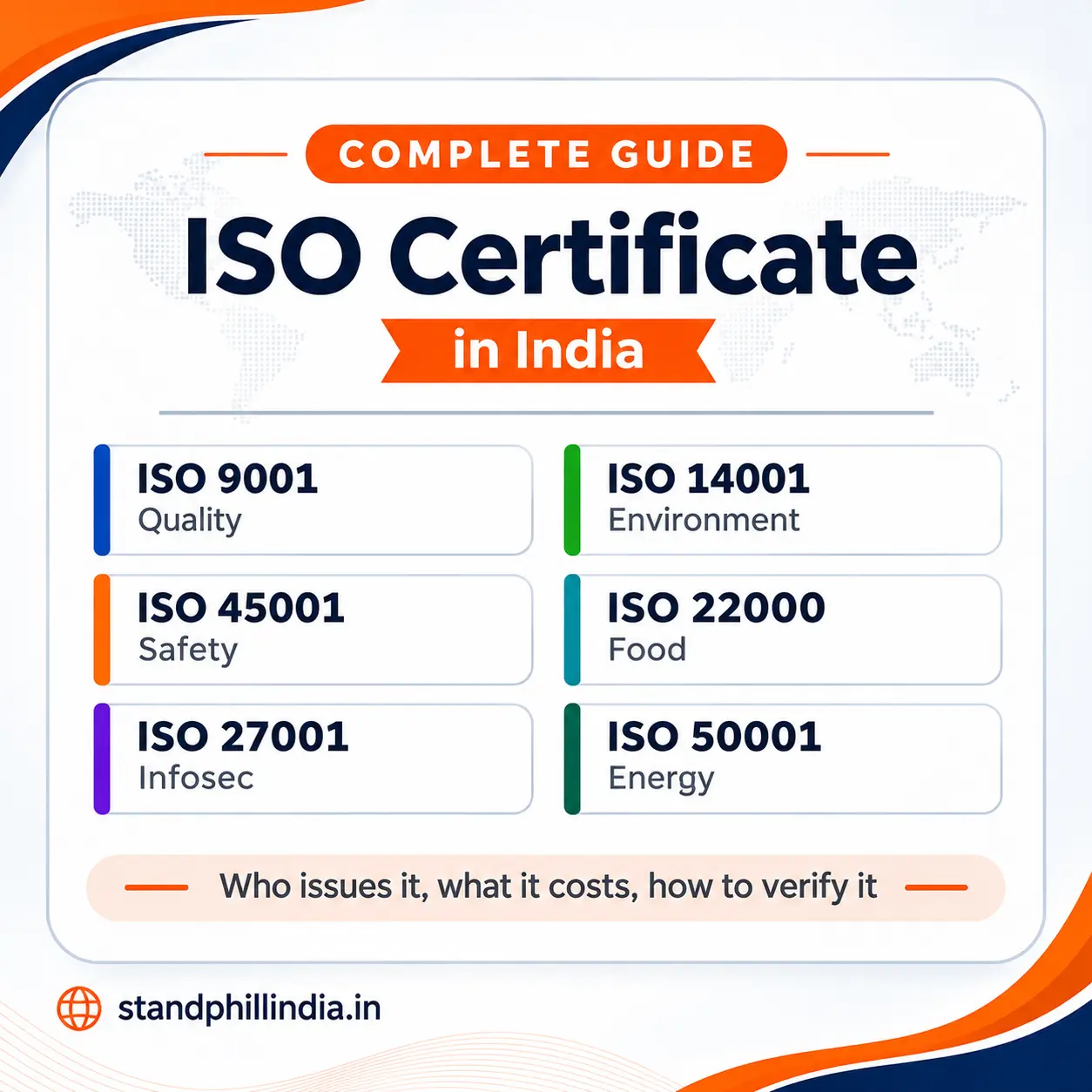
That last sentence is where most misunderstanding begins. A manufacturer who holds ISO 9001 has not had any product tested. What has been examined is whether the organisation plans its work, controls its documents, trains its people, monitors its suppliers, records what goes wrong and acts on it. An organisation with an excellent management system can still make a product that fails a specification, and a product that meets every specification can come from a factory with no management system worth the name. The two questions are different, and they are answered by different certificates.
ISO is the International Organization for Standardization, based in Geneva, a federation of national standards bodies. India's member body is the Bureau of Indian Standards. ISO publishes the standards - ISO 9001, ISO 14001, ISO 27001 and some twenty-five thousand others - and keeps them under review. What ISO does not do is certify anybody, a point explained in the next section because it changes how you should buy.
| Term | What it actually means |
|---|---|
| ISO | The organisation in Geneva that writes international standards. It is not a certifier and not a regulator. |
| ISO 9001 | A specific standard - in this case the requirements for a quality management system. The number identifies the standard, not a grade or a level. |
| IS/ISO 9001 | The same standard adopted in India as an Indian Standard by BIS. The technical content is identical. |
| ISO certification | A certificate issued by an independent certification body after auditing your management system against that standard. |
| Accreditation | Approval of the certification body itself, by an accreditation body such as NABCB. It is what makes a certificate worth something. |
ISO certification is also quite different from the ISI Mark and other BIS product schemes, which certify that a product conforms to a specification and are compulsory for notified goods. We compare the two in detail in our guide to the differences between ISI and ISO certification.
Who Issues ISO Certificates? Not ISO
ISO states the position in its own words: it does not perform certification or issue certificates, and it does not permit anyone to use the ISO logo in connection with certification. No organisation anywhere is certified "by ISO".
Myth check
Claim: a company can be certified by ISO, and can display the ISO logo once it is.
Verdict: false on both counts.
ISO is a standards development organisation. It publishes ISO 9001 and the rest, and it stops there. Certification is carried out by separate commercial or statutory bodies that audit your organisation and issue a certificate in their own name. The ISO logo is a registered trademark reserved for ISO's own use, and certified organisations are not licensed to display it.
The practical consequence is that the words "ISO certified" carry no information on their own. What matters is who certified you and who accredited them. Those two questions separate a certificate that will survive a tender scrutiny from one that will not.
Sources: ISO's own certification page, which states that ISO does not perform certification or issue certificates and does not permit use of the ISO logo in connection with certification; ISO/IEC 17021-1, the standard that governs bodies providing management system certification.
Strictly speaking, then, an organisation is not "ISO certified" at all. It is certified by a certification body as conforming to an ISO standard. The shorthand is so common that nobody will object to it in conversation, but the distinction matters the moment a buyer, an auditor or a tender committee starts asking questions.
The Accreditation Chain, Explained
Five parties sit between the standard and your certificate. Understanding the chain is the quickest way to judge whether a certificate is worth anything.
Writes and publishes the standard. Certifies nobody, accredits nobody, and charges you nothing.
The International Accreditation Forum. Its Multilateral Recognition Arrangement makes an accredited certificate issued in one country recognised in others.
India's accreditation body, under the Quality Council of India and a signatory to the IAF arrangement. It accredits certification bodies against ISO/IEC 17021-1.
Audits your organisation and issues the certificate in its own name, under its own mark.
Holds the certificate, displays the certification body's mark, and is audited again each year.
Two points about this chain repay attention, because they are where certificates fail.
Accreditation is granted per standard, not in general. A certification body accredited for ISO 9001 is not automatically accredited for ISO/IEC 27001 or ISO 13485. A body may hold accreditation for three standards and sell certificates for eight. The three are accredited; the other five are not, whatever the certificate looks like. Before signing, ask for the body's accreditation number and confirm that your standard and your scope fall inside its accredited scope.
Accreditation bodies other than NABCB are perfectly acceptable, provided they are recognised under the IAF arrangement. A certificate from a body accredited by UKAS in the United Kingdom or ANAB in the United States is recognised in India on the same footing. What is not acceptable is a certificate from a body accredited by nobody, or by a private "accreditation" outfit that exists only to issue accreditation certificates to its own customers.
Which Bodies Issue ISO Certificates in India?
There are hundreds. They fall into three groups, and the differences between them matter more than price.
| Type of body | Examples of what they are | What to understand |
|---|---|---|
| The statutory body | The Bureau of Indian Standards, operating its Management Systems Certification Scheme | The only organisation in India running a management systems certification scheme under an Act of Parliament. Certificates are issued as a licence under the BIS Act, 2016. |
| International certification bodies | Large global registrars with Indian operations | Widely recognised by overseas buyers; generally the most expensive. Useful where your customers are abroad. |
| Indian accredited certification bodies | Bodies accredited by NABCB and listed in its directory | The mainstream choice. Cost and service vary considerably; accreditation scope varies more. |
| Non-accredited certificate sellers | Firms issuing certificates with no recognised accreditation behind them | Cheap, fast and frequently worthless for tenders and serious buyers. Dealt with in the next section. |
A reasonable way to choose is to work backwards from who will read the certificate. If an Indian government tender or an RDSO registration is the reason you are certifying, a NABCB-accredited body is the natural choice and BIS is worth considering. If a European or Japanese customer has asked, a body with recognition in that market may serve you better. If nobody has asked and you simply want the discipline of a managed system, choose on audit quality rather than on fee.
Does BIS Issue ISO Certificates Itself?
Yes. The Bureau of Indian Standards has operated a Management Systems Certification Scheme since 1991, starting with quality management certification to IS/ISO 9001. It is the only organisation in India that runs such a scheme under an Act of Parliament, and it is the route people mean when they ask for a certificate from BIS. A BIS management system licence runs for three years and is granted by the Deputy Director General of the region.
This surprises manufacturers who think of BIS only as the body behind the ISI Mark. The two activities are entirely separate. Product certification under Scheme I, or Scheme II for electronics, certifies goods against an Indian Standard. Management systems certification sits in Scheme III of the same Regulations and certifies the organisation against a management system standard. Same authority, different scheme, different document.
Which ISO Standards Does BIS Certify?
BIS's own Manual for Management Systems Certification and its guidelines for applicants name the following. Each has a prescribed application form, which is the clearest evidence that the scheme is live for that standard.
| Standard | Management system | BIS form |
|---|---|---|
| IS/ISO 9001 | Quality management system | Form IV and Form V |
| IS/ISO 14001 | Environmental management system | Form IV and Form VII |
| IS/ISO 45001 | Occupational health and safety | Form IV, with the OH and S annexure |
| IS/ISO 22000 | Food safety management system | Form IV and Form XIII |
| IS/ISO 50001 | Energy management system | Form IV and Form XV |
| IS/ISO 13485 | Medical device management system | Form IV and Form XVI |
| IS 15700 | Service quality management by public service organisations | Form IV and Form XIV |
| IS 15000 | HACCP, for food businesses | Form IV and Form XIII |
| IS 16001 | Social accountability management system | Form IV and Form XVII |
| IS/ISO 21101 | Adventure tourism safety management system | Form IV with the relevant annexure |
| IS/ISO 21001 | Educational organisations management system | Form IV with the relevant annexure |
| Sector schemes: conformity assessment for milk and milk products to IS/ISO 22000 with process certification, ready mixed concrete, and road traffic safety management. BIS has added systems over time, so confirm current availability for your standard with your regional office. | ||
ISO 27001 is the common gap. Information security management has appeared in BIS presentations as a newer system under certification, but it is not among the standards with a long-established published form. If you need ISO 27001, assume you will go to a private accredited certification body unless BIS confirms otherwise in writing for your case.
Who Can Apply Through the BIS Scheme?
BIS puts it broadly: any organisation that can consistently provide products or services meeting customer and regulatory requirements, together with the requirements of the relevant standard. There is no restriction to manufacturers, and no minimum size. Applications go to the concerned BIS Regional Office on the prescribed forms with the application fee, and the form and questionnaire must be signed by the proprietor, a partner, the Managing Director, or another person authorised to sign for the organisation.
How the BIS Route Works, in Short
Registration runs under Scheme III. You apply to your BIS regional office on Form IV together with the annexure for your standard, the questionnaire, a copy of the quality manual and the non-refundable application fee, signed by the proprietor, a partner, the Managing Director or another authorised signatory. BIS then carries out an adequacy audit, which is a desk review of your documented information against the standard; a Stage 1 preliminary visit to assess the site, its scale and how far the system is genuinely implemented; and a Stage 2 certification audit, after which any non-conformities must be closed through root cause analysis and corrective action within a set timeframe. The Deputy Director General (Region) then grants the licence. It runs for three years, with surveillance at least once a year and the first surveillance no more than twelve months after the last day of the Stage 2 audit. Renewal is on Form IV again, for a further three years.
One requirement catches almost every applicant out. At least one internal audit and one management review must already be complete, with records, before you apply - not before the Stage 2 audit. A firm that applies in the week it finishes writing its manual has nothing to show for either, and the application stalls at the first step. Build in two to three months of actually running the system first.
The statutory fees have three heads: an application fee, an audit fee charged per man-day, and a licence fee covering three years, with concessions for micro, small and medium enterprises. The man-days are what move the total, because they follow the size and complexity of the organisation rather than anything you choose. The published figures, the full documents list, the form for each standard and the surveillance and renewal conditions are set out stage by stage on our BIS ISO 9001 certificate registration and consultancy services page.
BIS also holds NABCB accreditation under the Quality Council of India for its quality management, environmental management and food safety management certification schemes, so a BIS certificate in those areas carries the same accreditation signal that a good private certificate carries. The scheme is operated in line with ISO/IEC 17021, the same international standard that governs private certification bodies, which is why the two routes produce comparable documents: three years, annual surveillance, recertification at the end.
BIS or a Private Certification Body?
Both produce a genuine ISO certificate. The choice is practical rather than a question of legitimacy.
BIS suits you if
Your buyer specifically asked for BIS, you already hold a BIS product licence and prefer one authority, you supply government or public sector buyers who recognise the BIS name, or you want the backing of the national standards body rather than a private company.
A private body suits you if
You need the certificate quickly, you want to choose your auditor and negotiate the audit schedule, you export to customers who recognise a particular international brand, or you need a standard BIS does not currently certify, such as ISO 27001.
We have no financial interest in either answer. We are not a certification body, we take no commission for steering clients, and we recommend whichever route fits the requirement in front of you. Our ISO certificate consultant page sets the two routes out side by side, and our wider guide to the BIS certificate and all ten BIS schemes explains where Scheme III sits among them.
Accredited vs Non-Accredited Certificates: the Cheap Certificate Problem
India has a large market in ISO certificates that are issued in days, cost a few thousand rupees, and are backed by no recognised accreditation. They are not illegal, and they are not worth buying.
The way to understand them is that anyone may audit anyone and issue a document. Nothing in law reserves the words "ISO 9001 certificate" to accredited bodies. What accreditation adds is an independent check that the certification body is competent, impartial and following ISO/IEC 17021-1 - including the requirement that it actually spends a defined number of auditor days on site, scaled to the size of your organisation.
| Point | Accredited certificate | Non-accredited certificate |
|---|---|---|
| Behind it | A certification body accredited by NABCB or another IAF-recognised body | Nobody, or a private body that accredits itself |
| Audit | On-site, by competent auditors, for a defined number of days | Often a form and an email; sometimes no audit at all |
| Time | Weeks, because the system has to exist and be working | Hours or days |
| Cost | Proportionate to the size and complexity of the organisation | A few thousand rupees |
| Verifiable | On the body's register, the NABCB directory and often IAF CertSearch | Nowhere independent |
| Accepted in tenders | Normally yes | Frequently rejected, and increasingly checked |
| Value to your business | A working system, plus the certificate | A PDF |
If an ISO certificate is offered to you for a few thousand rupees with same-day delivery and no site visit, what is being sold is a document, not a certification. For a tender that is checked, or a customer audit, it is worse than having nothing, because producing a certificate that cannot be verified raises a question about everything else you have submitted.
Is an ISO Certificate Mandatory?
No Indian law makes ISO certification compulsory for a business in general. It becomes effectively compulsory when somebody you need - a tender authority, a customer, a regulator or a platform - makes it a condition.
That distinction matters because it changes who you should be satisfying. A statutory requirement is satisfied by complying with the statute. A contractual or tender requirement is satisfied by producing a certificate that the reader accepts, which is why the identity of the certification body and its accreditation matter so much more here than in product certification.
Where it is effectively required
RDSO vendor registration for Indian Railways; many central and state government tenders; public sector purchase conditions; large private buyers' supplier approval; some export customers; certain regulated sectors where a specific standard is specified.
Where it is genuinely voluntary
Most domestic trade, where it is taken as evidence of seriousness rather than a condition of sale. Here the value is in the system itself, and in the credibility it gives when a buyer does start asking.
Compare this with BIS product certification, where a Quality Control Order can make the ISI Mark or a CRS registration a legal condition of manufacture and sale. Nothing equivalent exists for ISO standards in India. A business that sells without ISO certification commits no offence; a business that sells a notified product without a BIS licence does.
ISO 9001 for Railway Tenders and RDSO Vendor Registration
For manufacturers who want to supply Indian Railways, a valid ISO 9001 certificate is a mandatory eligibility requirement for RDSO vendor registration. Without it, the application does not proceed.
The Research Designs and Standards Organisation, RDSO, maintains the approved vendor lists from which Indian Railways buys technical items - track components, signalling equipment, electrical and mechanical assemblies, fasteners and much else. Manufacturers who are not on the relevant list cannot bid for those items, however competitive their price. RDSO's own vendor-registration directives state that the vendor should possess a valid ISO 9001 certificate for the manufacture of the same or similar item at his works, and record this as a mandatory requirement for all vendors.
| Point | Position |
|---|---|
| Standard required | ISO 9001, the quality management system standard |
| Scope of the certificate | Must cover the manufacture of the same or similar item, at the works being registered. A certificate for a different activity or a different address does not serve. |
| Who may register | RDSO registers original equipment manufacturers. Traders and resellers are not permitted. |
| How to apply | Online through the RDSO vendor registration portal, which has been the route since December 2010 |
| What else is assessed | Technical capability, plant and testing equipment, the quality assurance system in practice, financial standing and prototype or sample testing against the RDSO specification |
The scope line is where applications fail. A certificate that reads "trading and supply of engineering goods" will not support a registration for manufacture, and one issued for a head office address will not support a works at a different location. Before you buy an ISO 9001 certificate for RDSO purposes, settle the exact wording of the scope and the address, and check them against the RDSO item description.
The same logic applies well beyond the railways. Public works departments, defence suppliers, power utilities, metro corporations and large private buyers all write ISO 9001 into eligibility clauses, and a growing number verify the certificate rather than merely collecting it. ISO 14001 and ISO 45001 appear in tender conditions too, particularly for construction, infrastructure and anything with a site safety dimension.
The Main ISO Standards Explained
The standards below account for the overwhelming majority of certification in India. They are not levels or grades: an organisation picks the ones that match its risks, and may hold several at once.
ISO 9001
Quality Management SystemThe oldest and by far the most common. It asks whether you understand your customers' requirements, plan and control your work, manage your suppliers and documents, measure what matters, and act when something goes wrong.
It is the standard written into most tender conditions, and the one RDSO requires.
Who it suits: almost any organisation, and effectively compulsory for anyone bidding for government or railway work.ISO 14001
Environmental Management SystemConcerns how the organisation identifies and controls its environmental impacts - emissions, effluent, waste, resource use and legal obligations - and how it improves them over time.
It does not set emission limits; it requires you to know your obligations and meet them.
Who it suits: manufacturing, construction, chemicals, and any organisation with pollution control consents or a buyer asking about sustainability.ISO 45001
Occupational Health and SafetyCovers worker safety: hazard identification, risk control, worker consultation, incident investigation and emergency preparedness. It replaced the older OHSAS 18001.
Who it suits: factories, construction, logistics, mining, and contractors bidding for sites where safety performance is scored.ISO 22000
Food Safety Management SystemBuilt around hazard analysis and critical control points, prerequisite programmes and traceability across the food chain, from primary production to packaging and distribution.
It sits alongside FSSAI licensing rather than replacing it.
Who it suits: food processors, packers, ingredient suppliers, caterers, cold chain and food packaging manufacturers.ISO/IEC 27001
Information Security Management SystemConcerns the confidentiality, integrity and availability of information: risk assessment, access control, supplier security, incident response and business continuity, with a defined set of controls.
Increasingly demanded in contracts rather than tenders, and the one customers most often audit.
Who it suits: IT and software companies, BPO and KPO, data centres, fintech, healthcare data handlers and anyone processing client data under contract.ISO 50001
Energy Management SystemA framework for measuring, monitoring and systematically reducing energy consumption - energy baselines, performance indicators, and action on the largest users first.
Of real financial value where energy is a major cost rather than an overhead.
Who it suits: energy-intensive manufacturing - steel, cement, textiles, chemicals, foundries - and large commercial buildings.Which Edition Is Current - and What Is Changing
Standards are revised, and a certificate against a withdrawn edition eventually stops being accepted. Two of the six were revised during 2026, which makes this the most important table on the page for anyone already certified.
| Standard | Subject | Current edition | Position |
|---|---|---|---|
| ISO 9001 | Quality management | ISO 9001:2026 | Published 16 September 2026, sixth edition, replacing ISO 9001:2015 |
| ISO 14001 | Environmental management | ISO 14001:2026 | Published 15 April 2026, fourth edition; ISO 14001:2015 and its 2024 amendment are withdrawn |
| ISO 45001 | Occupational health and safety | ISO 45001:2018 | With Amendment 1:2024. A revised edition is at Draft International Standard stage, expected in 2027 |
| ISO 22000 | Food safety | ISO 22000:2018 | With Amendment 1:2024. A revision is in progress |
| ISO/IEC 27001 | Information security | ISO/IEC 27001:2022 | With Amendment 1:2024. The 2013 edition ceased to be valid after 31 October 2025 |
| ISO 50001 | Energy management | ISO 50001:2018 | With Amendment 1:2024. Confirmed by systematic review in August 2024; no revision in progress |
How transitions work. The standard itself almost never contains a deadline - its foreword says only that it replaces the previous edition. The transition window, the date after which new certificates to the old edition stop being issued and the date the old certificates cease to be valid all come from the International Accreditation Forum and are applied by accreditation bodies and certification bodies. Normal practice is three years from publication. Confirm the date applying to your certificate with your certification body rather than relying on any figure quoted online.
Each of the six has a guide of its own covering its requirements, its current edition, the process and the cost: ISO 9001, ISO 14001, ISO 45001, ISO 22000, ISO 27001 and ISO 50001.
Others appear regularly in Indian tenders and contracts without being in this first tier: ISO 13485 for medical device quality management, ISO 37001 for anti-bribery, ISO 21001 for educational organisations, ISO 20000-1 for IT service management and ISO 22301 for business continuity. The principles below - accreditation, scope, audit, surveillance, verification - apply identically to all of them.
Which ISO Standard Does Your Organisation Need?
Start from the reason you are certifying. If somebody has asked, certify to what they asked for. If nobody has asked, certify to the standard that addresses your largest risk.
| Your situation | Standard | Why |
|---|---|---|
| Bidding for railway supply, or seeking RDSO vendor registration | ISO 9001 | A mandatory eligibility requirement for RDSO vendor registration |
| Bidding for government or PSU tenders generally | ISO 9001, sometimes with 14001 and 45001 | The usual eligibility trio in works and supply tenders |
| An Indian or export customer has asked for "ISO" | ISO 9001 | Unless they named another standard, this is what is meant |
| You handle client data under contract | ISO/IEC 27001 | The standard customers audit, and increasingly a contractual condition |
| You process, pack or distribute food | ISO 22000 | Food safety across the chain, alongside your FSSAI licence |
| Energy is one of your three largest costs | ISO 50001 | The savings can exceed the certification cost |
| You have pollution control consents and environmental obligations | ISO 14001 | Demonstrates systematic control of environmental impacts |
| Site safety performance is scored in your tenders | ISO 45001 | The recognised occupational health and safety standard |
| You manufacture medical devices | ISO 13485 | The sector-specific quality standard, separate from ISO 9001 |
Integrated certification. Where an organisation needs two or three standards - commonly 9001, 14001 and 45001 - they can be audited together as an integrated management system. One set of documents, one audit programme, one surveillance visit. It costs appreciably less than three separate certifications and is far less disruptive.
Is There an ISO Logo? What You May and May Not Display
There is no ISO logo for certified organisations. ISO does not permit its logo to be used in connection with certification, and the ISO logo is a registered trademark reserved for ISO's own use.
What a certified organisation displays is the certification body's own mark, under that body's rules - and every certification body has a different one. There is therefore no single image that means "ISO certified", which is why two certified companies' websites carry marks that look nothing alike. Some certificates additionally carry the accreditation body's symbol, such as the NABCB mark, where the body is accredited and the rules of that accreditation permit it.
| Mark | May you use it? | Notes |
|---|---|---|
| The ISO logo | No | Reserved for ISO itself; not licensed to certified organisations in any circumstances |
| Your certification body's certification mark | Yes | Under that body's rules, which usually cover size, colour, placement and the wording beside it |
| The accreditation body's symbol (for example NABCB) | Conditionally | Only as the accreditation body's own conditions permit, normally in combination with the certification body's mark |
| Either mark on a product or its packaging | No | NABCB's conditions bar management system certification marks from appearing on product packaging or labels in a way that suggests the product itself is certified |
| A written statement of certification | Yes | For example, naming the standard, the certification body and the certificate number. This is always safe and often clearer than a logo |
The last row but one catches a great many manufacturers. A management system certificate says something about your organisation, not about any individual item you make. Printing an ISO mark on the carton implies the product was certified, which it was not - and it is the kind of thing a customer's auditor notices immediately.
What an ISO Certificate Actually Looks Like
There is no standard design. Every certification body uses its own layout, wording and colours, so two genuine ISO certificates can look completely different. What they all carry is the same set of facts - and knowing those eight items is what lets you judge a certificate in under a minute.
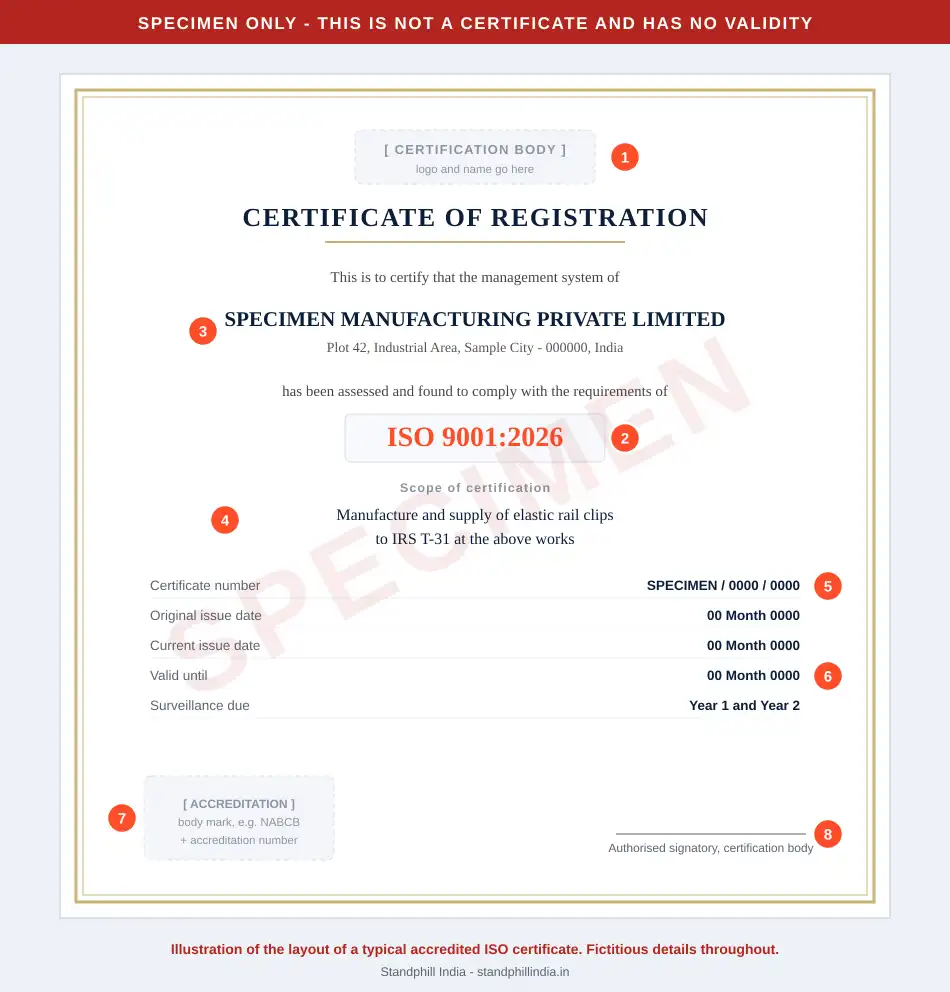
The Eight Things Every Genuine Certificate Carries
| What it is | What to check, and why it matters | |
|---|---|---|
| 1 | Certification body | The name and mark of the body that issued it. This is the organisation you contact to verify the certificate, and the one whose accreditation decides whether it is worth anything |
| 2 | Standard and edition | Not just "ISO 9001" but "ISO 9001:2026". The year tells you which edition was assessed. A certificate against a withdrawn edition is on borrowed time |
| 3 | Organisation and address | The exact legal entity and the site covered. A certificate naming a head office does not cover a factory, and one naming a parent company does not cover a subsidiary |
| 4 | Scope of certification | The most important sentence on the document. It states what activity was certified. "Manufacture of X" and "trading in X" are very different claims |
| 5 | Certificate number | The unique reference you quote when verifying with the certification body or searching IAF CertSearch |
| 6 | Dates | Original issue, current issue and expiry. An ISO certificate runs three years. If the expiry has passed, or surveillance was missed, it is not current |
| 7 | Accreditation mark | The symbol and number of the accreditation body, such as NABCB. Its absence does not prove a certificate is fake, but it does mean nobody independent has assessed the issuer |
| 8 | Authorised signature | Signed for the certification body. An unsigned certificate, or one signed by the consultant who built the system, is a serious warning sign |
If any of items 2, 3, 4 or 7 is vague, treat the certificate as weak. Those four are what a buyer, an auditor or a government scrutineer actually reads. A certificate that says only "ISO 9001 certified" with no edition, no scope and no accreditation reference tells a knowledgeable reader that no meaningful audit took place.
How to Get an ISO Certificate
Build the management system, run it long enough to generate records, audit it yourself, then have a certification body audit it in two stages and issue the certificate.
Gap analysis
Current practice against the standard
Build
Documents, processes, training
Operate
Generate real records
Internal audit
And management review
Stage 1 audit
Readiness and documentation
Stage 2 and grant
Full audit, then certificate

Stage 1 - Gap analysis. Compare what the organisation already does against what the standard requires. Most established businesses are further along than they expect: they already inspect, record and correct. What is usually missing is consistency and evidence rather than activity.
Stage 2 - Build the system. Write down the processes that matter, define responsibilities, set up document and record control, and train the people who will operate it. Resist the temptation to buy a template manual and change the company name. Auditors recognise them instantly, and a system nobody follows generates no records to show.
Stage 3 - Operate it. This is the step applicants most often try to skip, and it cannot be skipped. The certification audit examines records, and records only exist if the system has actually run. A period of real operation - commonly one to three months - is needed before there is anything to audit.
Stage 4 - Internal audit and management review. Both are explicit requirements of the standards. You audit yourself, record what you find, fix it, and hold a documented management review. A certification body will look for both early, and their absence stops the audit.
Stage 5 - Stage 1 audit. The certification body reviews the documented system and assesses whether you are ready. Findings here are normal and are meant to be addressed before Stage 2.
Stage 6 - Stage 2 audit and certification decision. The auditors examine the system in operation across the scope, interview staff and sample records. Non-conformities are classified as minor or major; minor ones are usually closed with a corrective action plan, while a major one requires evidence of correction before the decision. An independent reviewer inside the certification body then takes the certification decision - the auditor does not issue the certificate.
Documents and Records Required
ISO standards require far less documentation than their reputation suggests. What they require is evidence that the system runs - and that evidence has to be real.
| Item | Notes |
|---|---|
| Scope statement | The activities and sites to be certified, in the exact wording that will appear on the certificate |
| Policy for the relevant standard | Quality, environmental, information security and so on, signed by top management |
| Process map or list of processes | How work actually flows through the organisation |
| Documented procedures where the standard requires them | Fewer than most people expect; the rest is left to the organisation |
| Risk and opportunity assessment | Central to every current ISO management system standard |
| Objectives and performance indicators | With evidence that they are monitored rather than merely stated |
| Training and competence records | Who is competent to do what, and how you know |
| Supplier evaluation records | How suppliers are selected and monitored |
| Internal audit reports | Covering the whole system over the audit cycle |
| Management review minutes | Against the specific inputs and outputs the standard lists |
| Non-conformity and corrective action records | Including what was found, what was done and whether it worked |
| Legal and regulatory register | Particularly for ISO 14001 and ISO 45001 |
| Business registration, factory licence and consents | Standard organisational evidence for the certification body's file |
Standard-specific additions follow from the subject: a statement of applicability and risk treatment plan for ISO/IEC 27001, hazard analysis and prerequisite programmes for ISO 22000, an energy review and baseline for ISO 50001, and an aspects and impacts register for ISO 14001.
ISO Certificate Cost in India
There is no standard price, and any firm quoting one without asking how many people you employ and how many sites you have is not quoting for an accredited certification.
The audit fee is driven chiefly by auditor days, which under ISO/IEC 17021-1 are calculated from the number of effective personnel, the complexity of the processes, the number of sites and the standard involved. A ten-person single-site workshop and a four-hundred-person multi-site manufacturer are not in the same bracket, and no honest quotation treats them as though they were.
| Cost element | What drives it |
|---|---|
| Certification body audit fee | Auditor days for Stage 1 and Stage 2, scaled to headcount, sites and complexity |
| Surveillance audit fees | Charged in years one and two of the cycle, typically smaller than the initial audit |
| Recertification audit | In year three, to renew for a further cycle |
| Travel and accommodation of auditors | On actuals, and material if your plant is remote or you have several sites |
| Consultancy, where used | Gap analysis, building the system, training and audit preparation |
| Your own internal cost | Staff time to build and run the system - usually the largest real cost, and the one most often ignored |
| Multiple standards | Integrated certification of two or three standards costs appreciably less than certifying each separately |
Ask every quotation to separate three things: the certification body's audit fee for the full three-year cycle, the consultant's professional fee, and travel. A quotation that gives one number for "ISO 9001 certification" hides which part you are actually buying - and whether any accredited audit is included at all.
Validity, Surveillance and Recertification
An accredited ISO certificate is valid for three years, subject to surveillance audits in years one and two. It is not a document you obtain once and file away.
| Year | What happens | If it does not happen |
|---|---|---|
| Year 0 | Stage 1 and Stage 2 audits, certification decision, certificate issued | No certificate |
| Year 1 | First surveillance audit, covering part of the system | The certificate may be suspended |
| Year 2 | Second surveillance audit | The certificate may be suspended and then withdrawn |
| Year 3 | Recertification audit, broader than a surveillance audit, before expiry | The certificate expires and a fresh initial certification is needed |
Two practical points follow. First, a suspended or withdrawn certificate is visible on the certification body's register, so letting surveillance lapse is not a private matter between you and the auditor. Second, changes have to be told to the certification body - a new site, a significant change of scope, a change of management or a major change in activity can all require an extension to the scope or an additional audit. A certificate that no longer describes what the organisation does is not much use when a tender committee reads it.
How to Verify an ISO Certificate
Never accept an ISO certificate at face value, including your own supplier's. Three checks settle it, and they take a few minutes.
- Check the certification body's own register. Accredited bodies publish a searchable list of their valid certificates. Search by company name or certificate number and confirm the certificate is current rather than expired, suspended or withdrawn.
- Check that the certification body is accredited - for that standard. Look it up in the NABCB directory of accredited certification bodies, or the directory of whichever IAF-recognised accreditation body is named. Confirm the accreditation is current and that the specific standard falls inside its accredited scope, because accreditation is granted standard by standard.
- Search IAF CertSearch. This is the global database run by the International Accreditation Forum, into which accredited bodies upload their valid certificates. Search by organisation name or certificate number.
Then read the certificate itself against the reason you are checking it. The scope must cover the activity you care about, the address must be the site that will do the work, and the dates must be current. A valid certificate for the wrong scope or the wrong site is of no help to a tender committee.
Note that participation in IAF CertSearch is not universal, so an absence there is not by itself proof that a certificate is fake. The accreditation body's directory and the certification body's own register are the more conclusive checks.
How to Spot a Fake or Worthless ISO Certificate
Forged certificates no longer give themselves away by poor typography. You cannot tell by looking - but these signs tell you where to look harder.
- No accreditation body named or shown. A certificate that names no accreditation body, or names one you cannot find under the IAF arrangement, is at best non-accredited.
- The certification body is not in any accreditation directory, or is accredited for other standards but not for the one on the certificate.
- The ISO logo appears on the certificate. ISO does not permit its logo in connection with certification, so its presence suggests the issuer does not know or does not care about the rules.
- It was issued in a day or two, with no site visit. An accredited audit requires auditor days on site.
- The price was a few thousand rupees, flat, regardless of the size of the organisation.
- The scope is vague - a line such as "all kinds of business activities" rather than a specific description of activities and sites.
- No certificate number, or a number that returns nothing on the issuer's register.
- "Lifetime validity" or no expiry date. Accredited certificates run for three years with surveillance.
- The address on the certificate is not the site that does the work.
If you are a buyer, make this check part of supplier approval rather than of the purchase order. If you are a seller who has discovered that an existing certificate is non-accredited, the remedy is a proper certification with an accredited body, not a different cheap certificate.
Common Mistakes
Most problems with ISO certification in India come from treating it as a document to buy rather than a system to run.
| Mistake | Consequence |
|---|---|
| Buying a cheap non-accredited certificate | Rejected at tender scrutiny or customer audit; the money is simply lost |
| Wrong scope wording on the certificate | Fails an RDSO registration or a tender that requires manufacture of a specific item |
| Certificate issued for the head office, not the works | Does not cover the site that makes the goods |
| Choosing a body not accredited for that particular standard | Accreditation is per standard; the certificate is effectively non-accredited |
| Buying a template manual and never operating the system | No records exist, and the Stage 2 audit cannot proceed |
| Skipping the internal audit and management review | Both are explicit requirements; their absence stops the audit |
| Missing a surveillance audit | Suspension and eventually withdrawal, visible on the public register |
| Printing an ISO mark on product packaging | Implies product certification that does not exist, and breaches the accreditation conditions |
| Not telling the certification body about a new site or changed scope | The certificate no longer describes the organisation |
| Assuming ISO certification replaces BIS certification | They are different things; a notified product still needs its BIS licence or registration |
How Standphill India Helps
We prepare organisations for accredited ISO certification and manage the project to the certificate - including the scope wording that decides whether it will be accepted where you need it.
Our starting point is unusual in this market, and deliberately so: we ask what the certificate is for. If it is for an RDSO registration, the scope has to name the manufacture of the item at the works. If it is for an export customer, the choice of certification body matters. If nobody has asked for it, we will say so, because a certificate nobody requires and no system supports is money spent for a PDF.
Standard and scope decision
Which standard you actually need, and the exact scope and address wording that will satisfy the tender, registration or customer you are targeting.
Gap analysis
A clause-by-clause review of current practice against the standard, with a list of what must be documented, changed or recorded.
System development
Documentation built around how your organisation actually works, not a template with the name changed, plus staff training.
Internal audit and review
Conducting the internal audit, preparing the management review and closing findings before the certification body arrives.
Certification body selection
Help choosing an accredited body whose accreditation covers your standard and scope, with the fee structure made clear before you commit.
Audit support and afterwards
Attendance at Stage 1 and Stage 2, closure of non-conformities, and surveillance support through the three-year cycle.
We are an independent consultancy. We do not issue ISO certificates and we are not a certification body - under ISO/IEC 17021-1 no organisation may both consult on and certify the same management system, and any firm offering to do both is telling you something important about the value of its certificate. Our role is to get you ready and to manage the process; the audit and the certificate come from an accredited certification body. See our certification consultancy, or speak to an ISO certificate consultant for Delhi NCR and the rest of India.
Find Out Which ISO Certificate You Need - and What the Scope Must Say
Tell us why you need the certificate - an RDSO registration, a tender, a customer requirement - along with your activity, site and headcount. We will confirm the standard, the scope wording that will be accepted, a realistic timeline and what the audit will involve, within one business day.
The Standards, One by One
ISO 9001 Certification - Quality Management ISO 14001 Certification - Environmental Management ISO 45001 Certification - Occupational Health and Safety ISO 22000 Certification - Food Safety ISO 27001 Certification - Information Security ISO 50001 Certification - Energy Management ISO 9001 for RDSO Vendor RegistrationRelated Guides
Difference Between ISI and ISO Certification BIS Certificate - All Ten BIS Schemes Explained ISI Mark Certification for Indian Manufacturers Compulsory Registration Scheme (CRS) ISO Certificate Consultant - Delhi NCR and IndiaFrequently Asked Questions - ISO Certificate and ISO Certification in India
Sources Used for This Guide
- ISO's own certification page, stating that ISO does not perform certification or issue certificates and does not permit use of the ISO logo in connection with certification.
- ISO/IEC 17021-1, the international standard for bodies providing audit and certification of management systems, including the determination of audit time and the bar on certifying a system the body has consulted on.
- NABCB (National Accreditation Board for Certification Bodies), Quality Council of India - directory of accredited certification bodies and conditions for use of the accreditation symbol.
- International Accreditation Forum - Multilateral Recognition Arrangement and the IAF CertSearch database.
- Bureau of Indian Standards - Management Systems Certification Scheme, operated since 1991 under the BIS Act, and the list of management system standards certified by BIS.
- Research Designs and Standards Organisation (RDSO), Ministry of Railways - vendor registration and vendor approval directives (document series QO-D-8.1), which record a valid ISO 9001 certificate for manufacture of the same or similar item at the works as a mandatory requirement for all vendors.
Ask About ISO Certification
Tell us the standard you need, why you need it, your activity and how many people you employ. We will confirm the right standard, the scope wording and a realistic timeline within one business day.
★ Why Standphill India?
- 20+ Years of BIS Certification Experience
- 10,000+ Certifications Delivered Globally
- Dedicated Teams for CRS, FMCS & ISI Mark
- End-to-End Documentation & Filing Support
- Fast Response & Practical Compliance Guidance
- Support for Indian & Foreign Manufacturers
Get Free Call Back
Our Services
- ISI MARK Certificate Registration
- BIS ISI Mark for Foreign Manufacturers
- BIS Certification for Furniture
- BIS Certification for Toys
- CDSCO Certificate
- PESO Certification
- LMPC Legal Metrology Certificate
- BIS Certification for Footwear
- Compulsory Registration Scheme (CRS)
- WPC-ETA Approval
- BEE Certification
- EPR Certification Registration
- EPR For Plastic Waste Management
- EPR Registration for Used Oil
- EPR For Battery Waste Management
- CE Certification
- UL Certification
- TEC/MTCTE Approval
- ROHS Licence
- Standardization Division
- Import/Export Licence
- FSSAI Certification
- MSME/SSI/NSIC Registration
- ISO Registration
- Brand Representation
- Lab Equipment And Setup
- Trademark Registration
- Make In India Support
Client Testimonials
Their team was very knowledgeable and helped us every step of the way. Standphill India is the best BIS certification consultants for any type of BIS certification.

Chintan Shah (AGM)
Sudeep Nutrition P.Ltd




Featured Guide
Complete BIS CRS certification guide for electronic products in India — free to read.
Read CRS Certification Guide📞 Contact Standphill India
+91-9667674225 info@standphillindia.in WhatsApp Now Greater Noida West, UPGet Expert BIS Certification Support for Your Business
Connect with Standphill India for complete support with BIS certification, CRS registration, WPC approval, FMCS compliance, and related regulatory services. Our team helps businesses with documentation, testing coordination, application support, and end-to-end compliance guidance.
Request Free Consultation
Share your requirement and our team will contact you shortly.