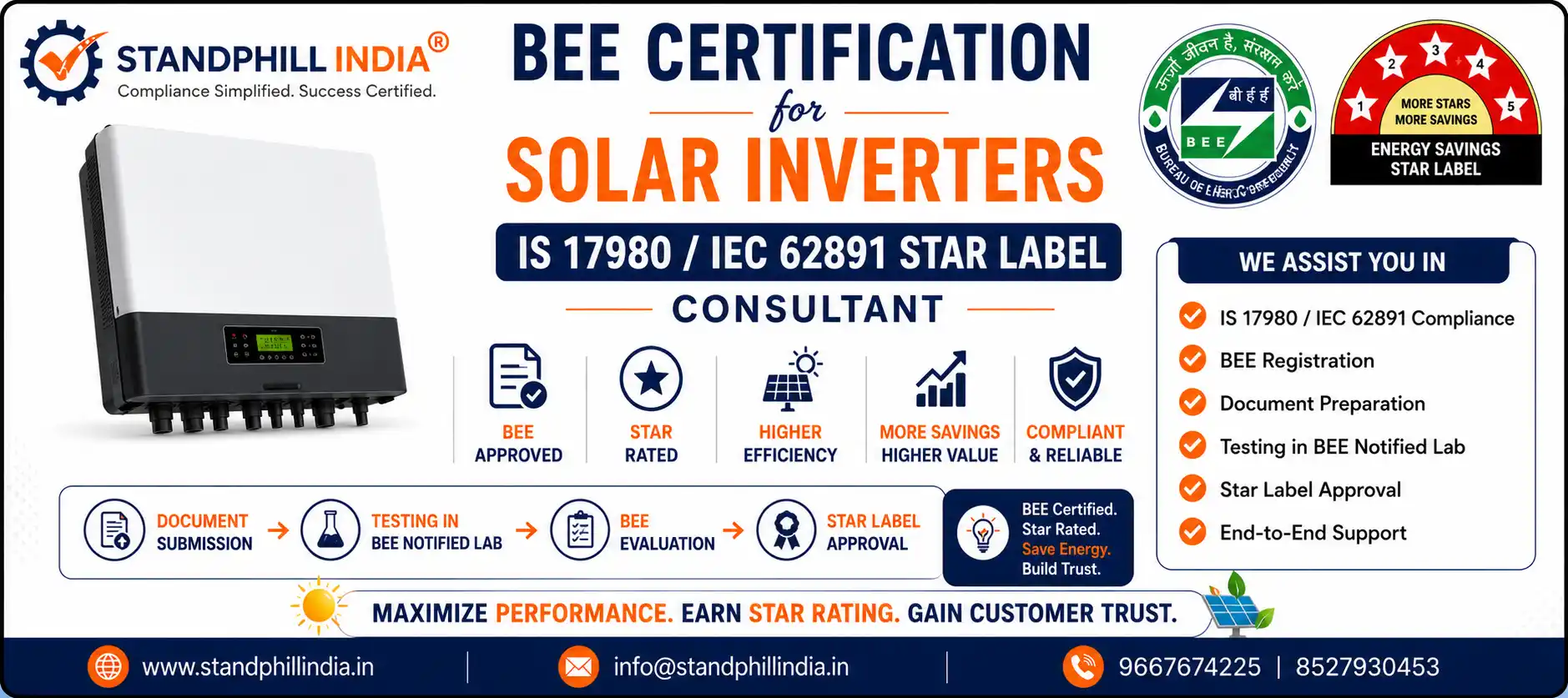
BEE Certification for Solar Inverters
Mandatory Endorsement Label from 1 Jan 2026 | MEPS under IS 17980 / IEC 62891 | Manufacturers & Importers
Quick Answer
Grid-connected solar (PV) inverters up to 100 kW need a mandatory BEE endorsement label from 1 January 2026, meeting minimum efficiency performance standards (MEPS) based on IS 17980:2022 / IEC 62891:2020. Inverters must also be BIS-certified under IS 16221-2:2015 before they can be labelled. Standphill India is an expert BEE certification consultant for solar inverters, handling testing, brand & model registration, label generation and renewals end-to-end. Call +91-9667674225.
Mandatory now - and deadlines have already hit: From 1 January 2026, grid-connected solar inverters up to 100 kW must meet BEE MEPS to be sold in India (in force to 31 December 2027). Manufacturers continuing previously registered models had to submit by 28 February 2026 or face deactivation; large inverters above 200 kW got an extension to June 2026. If your inverter models are not registered, they cannot be supplied to new projects. Check your model status now.
Need a BEE star label for your solar inverters?
Free applicability check & timeline within 24 hours.
BEE Certification for Solar Inverters - Overview
As India races toward its renewable-energy targets, the solar inverter - the device that converts panel DC into grid-quality AC - has moved from a voluntary efficiency programme to a mandatory one. From 1 January 2026, all single-phase (230 V AC, 50 Hz) and three-phase (up to 415 V AC, 50 Hz) non-storage, grid-connected solar inverters up to 100 kW must meet BEE's minimum efficiency performance standards (MEPS) and carry the BEE endorsement label.
The efficiency thresholds are notified under the BEE Standards & Labelling programme and tested to IS 17980:2022 / IEC 62891:2020. MEPS rises with capacity: roughly 92% below 1 kW, 93% for 1-3 kW, 95% for 3-5 kW, 96% for 5-10 kW, 97% for 10-20 kW and 98% above 20 kW (up to 100 kW). The figure is based on steady-state conversion efficiency combined with static MPPT efficiency, so it reflects real conversion performance rather than a peak headline number.
Crucially, BEE labelling sits on top of a BIS prerequisite: inverters must be BIS-certified under IS 16221-2:2015 to be eligible for the endorsement label, and only models tested under IS 17980:2022 or IEC 62891:2020 qualify. This makes solar inverter compliance a two-layer project. Standphill India runs both layers - BIS under IS 16221-2 and BEE MEPS labelling - coordinating accredited testing, managing the tight 2026 continuation deadlines, and handling importer-route registration for inverters sourced from China and elsewhere.
How the BEE Star Rating Works for Solar Inverters
Solar inverters are not star-rated like appliances - they carry an endorsement label confirming they meet a minimum efficiency floor:
- BEE sets a minimum efficiency performance standard (MEPS) the inverter must meet to be sold
- MEPS scales with capacity: ~92% (<1 kW), 93% (1-3 kW), 95% (3-5 kW), 96% (5-10 kW), 97% (10-20 kW), 98% (>20 kW), up to 100 kW
- Efficiency = steady-state conversion efficiency combined with static MPPT efficiency
- Tested under IS 17980:2022 or IEC 62891:2020 at an accredited lab
- BIS certification under IS 16221-2:2015 is a prerequisite before BEE labelling
- The label carries model number, rated output power and verified efficiency
EPCs and installers take note: from 2026 onward, only BIS-certified, BEE-labelled inverters can be used in new grid-connected projects. Buyers must verify inverter certificates, test reports and label authenticity - so an unlabelled inverter is effectively unsellable into the project market.
Solar Inverters BEE Certification - Key Facts
| Product | Solar Inverters |
| Issuing Authority | Bureau of Energy Efficiency (BEE), Ministry of Power |
| Legal Basis | Energy Conservation Act, 2001 |
| Applicable Standard(s) | IS 17980:2022 / IEC 62891:2020 (efficiency); BIS prerequisite IS 16221-2:2015 |
| Rating Basis | Minimum overall efficiency (MEPS), 92-98% by capacity band, per IS 17980:2022 / IEC 62891:2020 |
| Status | Mandatory from 1 Jan 2026 - grid-connected inverters up to 100 kW (in force to 31 Dec 2027) |
| Label Validity / Period | Mandatory compliance window 1 Jan 2026 - 31 Dec 2027; continuation submissions were due 28 Feb 2026; >200 kW extended to June 2026 |
| Applicant | Manufacturer (Indian) / Importer (for imported goods) |
| Registration Levels | Brand/company registration + model-wise registration |
| BIS Prerequisite | IS 16221-2:2015 (inverter must be BIS-certified before BEE labelling) |
| Scope | Single-phase 230 V & three-phase up to 415 V, 50 Hz, non-storage, grid-connected, up to 100 kW |
Importing solar inverters into India?
We structure the importer-route BEE registration + handle every model. Worldwide support.
Where Solar Inverters BEE Labels Matter
Rooftop Solar
Residential & commercial PV
C&I Solar
Factories, offices, malls
Utility Projects
Grid-connected plants up to 100 kW units
Residential Solar
Single-phase home inverters
Inverter Makers
Indian PV inverter brands & OEMs
Importers
Imported inverters (e.g. from China)
EPC & Installers
Must use labelled inverters
Green Energy
Renewable procurement & tenders
BEE Registration Process for Solar Inverters
Applicability Check
Confirm status & IS 17980 / IEC 62891 scope
Lab Testing
NABL/BEE-approved lab Efficiency (MEPS) test
Brand Registration
Company & brand on BEE portal
Model Registration
Upload reports; generate label
Star Label
Affix label; manage renewal
Typical timeline: a few weeks to a couple of months, driven mainly by lab testing and document readiness. Standphill India runs all five stages for you.
Documents Required
- Company incorporation / registration
- GST & PAN
- Brand / trademark certificate
- Authorised signatory letter
- Copy of valid BIS certificate (IS 16221-2:2015) - prerequisite
- ISO 9001 of manufacturing unit (if available)
- NABL/BEE-approved lab test report (Efficiency (MEPS))
- Model technical specifications
- Sample BEE label / specimen
- User manual & product images
- Security deposit payment receipt
- For importers: import & authorisation papers
BEE Certification Fees for Solar Inverters
Cost Components
Fees vary by number of models and applicant type (manufacturer vs importer). Contact us for a transparent, itemised quote within 24 hours.
Related BEE Certifications
Why Standphill India - Your BEE Consultant for Solar Inverters
Solar inverter compliance is uniquely demanding - a BIS prerequisite (IS 16221-2), MEPS testing to IS 17980/IEC 62891, and 2026 deadlines that have already deactivated unregistered models. Standphill India is a specialist BEE certification consultant for solar inverters: we sequence BIS first, then MEPS efficiency testing and BEE endorsement labelling, manage continuation and new-model registration, and structure importer-route filings for overseas inverter brands. Indian manufacturers and importers, end-to-end.
Get Your Solar Inverters BEE Star Label - Fast & Compliant
From applicability check to label-in-hand, Standphill India delivers your solar inverters BEE registration end-to-end. Indian or imported, one model or a hundred.
Get a Free Quote +91-9667674225Frequently Asked Questions
Ask Our BEE Consultants - Solar Inverters
Tell us your models & whether you're a manufacturer or importer - reply with status & quote within one business day.
★ Why Standphill India?
- 20+ Years of BIS Certification Experience
- 10,000+ Certifications Delivered Globally
- Dedicated Teams for CRS, FMCS & ISI Mark
- End-to-End Documentation & Filing Support
- Fast Response & Practical Compliance Guidance
- Support for Indian & Foreign Manufacturers
Get Free Call Back
Our Services
- BIS (ISI Mark) for Foreign Manufacturers
- Domestic BIS (ISI Mark) Certification
- BIS Certificate of Conformity (CoC)
- BIS Hallmarking
- BIS Licence for Toys
- ECO Mark Certification
- TAC Approval for Automobile
- Drug Licence
- Peso Certification
- BIS (CRS) Registration
- WPC-ETA Approval
- BEE Certification
- E-Waste Management (EPR)
- EPR for Plastic Waste
- EPR for Battery Waste
- CE Certification
- UL Certification
- ROHS Licence
- Standardization Division
- Import / Export Licence
- FSSAI Certification
- ISO Registration
- Trademark Registration
- Make in India Support
- AG-Mark Licence
- Third Party Monitoring
Client Testimonials
Their team was very knowledgeable and helped us every step of the way. Standphill India is the best BIS certification consultants for any type of BIS certification.

Chintan Shah (AGM)
Sudeep Nutrition P.Ltd



Featured Guide
Complete BIS CRS certification guide for electronic products in India — free to read.
Read CRS Certification Guide📞 Contact Standphill India
+91-9667674225 info@standphillindia.in WhatsApp Now Greater Noida West, UPGet Expert BIS Certification Support for Your Business
Connect with Standphill India for complete support with BIS certification, CRS registration, WPC approval, FMCS compliance, and related regulatory services. Our team helps businesses with documentation, testing coordination, application support, and end-to-end compliance guidance.
Request Free Consultation
Share your requirement and our team will contact you shortly.