BIS Certification for Bearings (ISI Mark)
Mandatory Under the Bearings (Quality Control) Order, 2025 - 12 Bearing Types, Exact Deadlines: 6 / 9 / 12 Months - Global BIS Consultancy by Standphill India
Quick Answer - BIS Certification for Bearings
BIS certification (ISI Mark) for bearings is mandatory in India under the Bearings (Quality Control) Order, 2025, issued by the Ministry of Commerce and Industry (DPIIT) under the BIS Act, 2016 (File No. P-29026/1/2025-LEI). It covers 12 bearing types under specific Indian Standards.
Exact implementation deadlines from the date of gazette publication: General manufacturers - 6 months · Small Enterprises - 9 months · Micro Enterprises - 12 months.
No covered bearing can be manufactured for domestic sale, imported, stocked, or sold in India without a valid BIS ISI Mark licence. Export-only bearings are exempt. Up to 200 units/year may be imported for R&D (not for sale, with record-keeping obligation).
Bearings Now Under Mandatory BIS - Your Deadline Is Counting Down
The Bearings QCO 2025 is in force from the date of gazette publication. If you are a general manufacturer, you have 6 months. If you are a small enterprise, 9 months. Micro enterprises get 12 months. BIS factory audits and lab testing typically take 8-14 weeks - so if you haven't started, every week of delay shrinks your compliance window. Don't wait for the last minute.
Need ISI Mark for Your Bearings?
Free consultation & exact deadline calculation within 24 hours.
What is the Bearings (Quality Control) Order, 2025 - and Why It Changes Everything
A bearing is one of the most functionally critical components in any rotating machine - from the wheels of your car and the axles of a railway wagon, to the spindle of a CNC machine, the rotor of a wind turbine, the motor of a ceiling fan, and the impeller of a water pump. If something rotates in a machine, a bearing is what makes it rotate smoothly, efficiently, and safely.
For decades, India's bearing market has absorbed large volumes of low-quality, sub-standard, and counterfeit bearings - many of them imported - that fail prematurely, cause machinery breakdowns, and in industrial and automotive contexts, create serious safety risks. A failed bearing in a vehicle wheel hub can cause an accident. A failed bearing in an industrial pump can trigger a production shutdown. In a power plant, it can cause catastrophic failure.
This is the problem the Bearings (Quality Control) Order, 2025 is designed to solve. Issued by the Ministry of Commerce and Industry (DPIIT) under the Bureau of Indian Standards Act, 2016, it makes the BIS ISI Mark mandatory for 12 categories of bearings - ensuring that every bearing sold in India, whether made here or imported, has been verified against a specific Indian Standard for dimensions, materials, load ratings, hardness, and durability before it reaches the market.
- Safety first - certified bearings meet verified dimensional tolerances, hardness, and load/endurance limits. Buyers know what they are getting.
- Counterfeits eliminated - without a valid BIS ISI Mark, bearings cannot be legally imported or sold, shutting out the sub-standard supply chain.
- Market access - OEMs, Tier-1 auto suppliers, defence procurement, and government infrastructure projects already demand or will soon require ISI-marked bearings from their supply chain.
- Customs enforcement - imported bearings without a valid ISI Mark licence will be held and rejected at Indian ports of entry.
- "Make in India" benefit - domestic bearing manufacturers who invest in quality get a level playing field against cheap, uncertified imports.
- Level playing field for global competition - genuine international manufacturers who already produce to high quality standards gain the certification that validates their quality to Indian buyers.
Official QCO - What the Gazette Actually Says (Verbatim Provisions)
The Bearings (Quality Control) Order, 2025 is published in the Gazette of India (Extraordinary, Part II, Section 3, Sub-section (ii)) under File No. P-29026/1/2025-LEI, signed by Sanjiv, Joint Secretary to the Government of India. Here are its key operative provisions in plain language:
Clause 1 - Short Title & Commencement: This Order shall be called the Bearings (Quality Control) Order, 2025. It comes into force from the date of publication of the notification in the Official Gazette.
Clause 2 - Compulsory Standard Mark: Goods listed in the Table must conform to the corresponding Indian Standard and bear the Standard Mark under a licence from BIS under Scheme-I of Schedule-II of the BIS (Conformity Assessment) Regulations, 2018.
Phased Implementation (from date of gazette): General manufacturers (other than Micro and Small Enterprises): Column (5) of the Table - Six months. Small Enterprises: Column (6) - Nine months. Micro Enterprises: Column (7) - Twelve months.
R&D Exemption (Proviso 1): Up to 200 units per year may be imported for R&D by bearing manufacturers, provided: (a) they are not sold commercially, (b) they can be disposed of as scrap, and (c) the manufacturer maintains a year-wise record and furnishes details to the Central Government.
Export Exemption (Proviso 2): Nothing in this Order applies to bearings manufactured domestically exclusively for export.
Clause 3 - Certification & Enforcement Authority: The Bureau of Indian Standards (BIS) is the certifying and enforcing authority.
Clause 4 - Penalty: Contravention is punishable under the Bureau of Indian Standards Act, 2016.
Table Note: "For the purposes of this Table, the latest version of Indian Standards including the amendments thereof, as notified by BIS from time to time shall apply."
Source: Government of India, Ministry of Commerce and Industry (DPIIT), File No. P-29026/1/2025-LEI - Bearings (Quality Control) Order, 2025.
What "Latest Version Including Amendments" Means for You: The QCO does not lock you to the exact year shown in the table. For example, IS 6457 is listed as IS 6457:2024. If BIS publishes IS 6457:2027 or an Amendment-1 to IS 6457:2024 before your inspection, your application and testing must reference the updated version. Standphill India monitors BIS standard revisions across all 12 bearing standards and alerts clients of any changes that affect their certification scope or testing requirements.
Exact Implementation Deadlines - 6, 9 & 12 Months from Gazette Publication
Unlike many QCOs that give vague phase descriptions, the Bearings QCO 2025 specifies exact timelines in the gazette table itself. All three deadlines are measured from the date of publication in the Official Gazette:
Critical: BIS Certification Takes 8-14 Weeks Minimum. If you are a general manufacturer with a 6-month window, you effectively have only 2-4 months to initiate the process if you want your licence before the deadline. Lab testing, factory audit scheduling, document preparation, and BIS portal scrutiny all take time - and for overseas manufacturers, international audit travel scheduling adds additional weeks. Contact Standphill India today to calculate your exact deadline and start immediately.
How to determine your enterprise category - your category (Micro, Small, or Medium/General) is defined under the MSME Development Act, 2006 (27 of 2006) and is based on your annual turnover and investment in plant & machinery. If you are registered under Udyam Registration as a Micro or Small enterprise, you get the extended deadline - and also significant discounts on BIS marking fees.
MSME Benefit - Extended Deadlines AND Up to 80% Off on BIS Marking Fees
Being an MSME under the Bearings QCO 2025 gives you two significant advantages: a longer compliance window (9 months for Small, 12 months for Micro) AND substantial discounts on BIS ISI Mark marking fees - the per-unit fee paid to BIS based on your annual production or import volume.
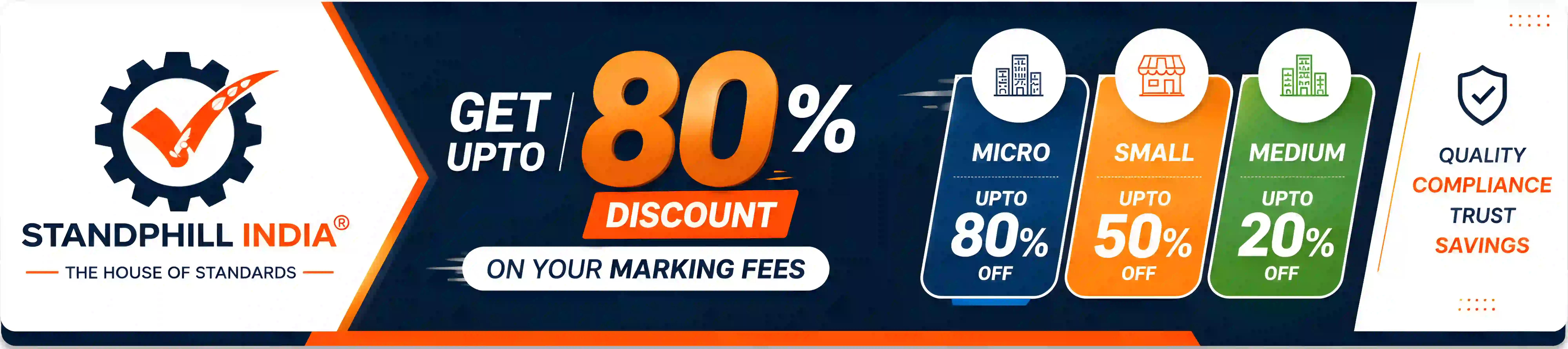
How to Claim Your MSME Discount: Submit your Udyam Registration Certificate with your BIS application. The discount applies only to marking fees - not to application, testing, or inspection fees. Standphill India verifies your MSME classification and ensures the correct fee slab is applied from Day 1 of your application.
All 12 Bearings Under the QCO - What Each Is, Its IS Standard, and Why It Matters
Each of the 12 bearing types in the QCO has its own Indian Standard, its own mechanical purpose, and its own testing requirements. Understanding which category applies to your product is the first step in getting the right BIS licence. Click each bearing to read the full explanation:
What Are Tapered Roller Bearings?
Tapered roller bearings have tapered (conical) inner and outer races and cone-shaped rolling elements (rollers) arranged so that the apex of each cone converges at a single point on the bearing axis. This geometry makes them uniquely capable of handling combined loads - both radial (perpendicular to the shaft) and axial (along the shaft) - simultaneously and in large magnitudes. They are typically used in pairs or sets because a single tapered roller bearing can only handle axial load in one direction.
What IS 12102:1987 Specifies
IS 12102:1987 specifies the dimensional and tolerance requirements for tapered roller bearings - including bore diameter, outside diameter, width, cone and cup geometry, and the designation system for identifying bearing series and sizes. The standard harmonizes with ISO 355 metric tapered roller bearing designation principles, ensuring dimensional interchangeability with internationally manufactured bearings.
What Are Self-Aligning Roller Bearings?
Self-aligning roller bearings (also called spherical roller bearings) have two rows of barrel-shaped rollers and a spherical outer race that allows the bearing to accommodate angular misalignment between the shaft and housing. This is their defining advantage: even if the shaft deflects under load, or if the housing is slightly misaligned during installation, the bearing continues to operate correctly. They carry heavy radial loads and moderate axial loads in both directions.
What IS 6454:1972 Specifies
IS 6454:1972 covers the specification for self-aligning (spherical) roller bearings - dimensional requirements, tolerance grades, and bearing series designations. These bearings are identified by their barrel-shaped rollers and spherical inner surface of the outer ring, which provides the misalignment compensation function.
What Are Single Row Deep Groove Ball Bearings?
The deep groove ball bearing is the most widely used bearing type in the world - and IS 6455:2020 covers the single-row version, which is the most common of all. These bearings have deep, continuous grooves in both the inner and outer rings that guide the balls and allow them to carry both radial and moderate axial loads in both directions. They are simple in construction, require minimal maintenance, operate at high speeds, and are available in sealed or open variants.
What IS 6455:2020 Specifies
IS 6455:2020 (the 2020 revision - the most recent for this type) specifies dimensions, tolerances, load ratings, and designation for single row radial deep groove ball bearings. The 2020 revision aligns this standard with the latest ISO 15:2017 framework for deep groove ball bearing dimensional standards. Note: IS 6455:2020 is specifically listed in the QCO gazette table - confirming this is the applicable version as of the QCO publication.
What Are Double Row Radial Ball Bearings?
Double row radial ball bearings essentially combine two single-row ball bearing raceways side-by-side within a single housing. This doubles the radial load capacity compared to a single-row bearing of the same bore diameter, while maintaining the same axial envelope. They are used in applications where space constraints prevent using two separate bearings but where higher load capacity is needed. They also offer higher moment load resistance than single-row bearings.
What IS 6456:1972 Specifies
IS 6456:1972 covers the specification for double row radial ball bearings - including bore sizes, outside diameters, total width, inner ring geometry, and designation. Though the year is 1972, the latest version including amendments applies per the QCO note.
What Are Single Row Cylindrical Roller Bearings?
Cylindrical roller bearings use cylindrical rollers instead of balls. Because the contact between a cylinder and a flat surface is a line (rather than a point for balls), cylindrical roller bearings can carry much higher radial loads than ball bearings of the same size. However, in standard form they have limited axial load capacity. Single-row cylindrical roller bearings are compact and suitable for high speeds. Different internal designs (NU, NJ, NUP, N, NF types) determine whether and in which direction axial forces can be guided.
What IS 6457:2024 Specifies
IS 6457:2024 is the newest version of this standard - notably updated in 2024, the year before the QCO was issued. This version specifies dimensions, tolerances, load ratings, and designation for single row cylindrical roller bearings aligned with current ISO 15 and ISO 281 frameworks. Manufacturers must ensure their testing and documentation references IS 6457:2024 specifically - not older versions.
What Are Double Row Cylindrical Roller Bearings?
Double row cylindrical roller bearings have two rows of cylindrical rollers side-by-side, nearly doubling the radial load capacity of a comparable single-row design while maintaining the same external dimensions. They are especially used in applications with very high radial loads and where stiffness of the shaft system is critical. Like single-row types, they have limited inherent axial load capacity.
What IS 6458:1972 Specifies
IS 6458:1972 specifies dimensional and tolerance requirements for double row cylindrical roller bearings. The latest version including amendments applies per the QCO note.
What Are Thin-Walled Plain Bearings?
Thin-walled plain bearings (also called thin-wall shell bearings or half-shell bearings) are split-line bearings made from thin strip metal with a friction-reducing lining material (typically white metal, lead-bronze, or aluminium-tin alloy) bonded to a steel backing. They are precision-formed into a half-cylindrical shape and used in pairs to form the main and connecting rod bearings in internal combustion engines. Their thin wall and precision bore make them completely interchangeable at the point of assembly - no fitting or machining required. This is why their dimensional precision and overlay thickness specification are critical.
What IS 10203:1982 Specifies
IS 10203:1982 specifies technical supply conditions for thin-walled plain bearings - covering dimensional limits, wall thickness tolerances, bore diameter, lining material composition requirements, surface finish, and marking. These bearings are unique in that they carry load through hydrodynamic lubrication (a film of oil between the bearing surface and journal) rather than rolling elements.
What Are Thick-Walled Bushes?
Thick-walled bushes are cylindrical plain bearings (bushings) made with a wall thickness large enough to be self-supporting when pressed into a housing. Unlike thin-walled shell bearings, they are full-round (without any joint or slit) and can be plain cylindrical or flanged (with a collar at one end for axial location). They are made from bimetallic strip (steel backing with bronze, white metal, or polymer lining) or solid bronze. They operate on hydrodynamic or boundary lubrication principles.
What IS 14478:1997 Specifies
IS 14478:1997 covers plain bearings - thick-walled bushes in plain and flange types, full-round (without any joint or slit). The standard specifies dimensional requirements, bore tolerances, outside diameter, width, flange dimensions (for flanged types), and material requirements.
What Are Ring Type Needle Bearings?
Needle roller bearings use very thin, long cylindrical rollers (needles) with a high length-to-diameter ratio - typically 3:1 to 10:1. This geometry allows them to carry very high radial loads in an extremely compact radial space. Ring type needle bearings have both inner and outer rings (as opposed to drawn cup needle bearings, which use the shaft or housing bore directly as a raceway). The small cross-section makes them the first choice when radial space is severely constrained but high load capacity is required.
What IS 4215:1983 Specifies
IS 4215:1983 specifies ring type needle bearings - covering bore diameter range, outside diameter, width, roller specifications, and designation. The standard defines both radial and thrust needle bearing configurations.
What Are Ring Type Thrust Washers?
Thrust washers are flat, ring-shaped plain bearing elements that carry axial (thrust) loads between rotating and stationary surfaces. Ring type thrust washers made from strip are manufactured from bimetallic strip material (steel backing with a bearing alloy lining) by stamping. They locate axially in a housing groove and resist the thrust forces generated by gears, helical threads, or bevel drive systems. They work under hydrodynamic or boundary lubrication conditions.
What IS 9764 (Part 1):2022 Specifies
IS 9764 (Part 1):2022 covers ring type thrust washers made from strip - specifying dimensions and tolerances for the outer diameter, inner diameter, and thickness. The 2022 revision updates dimensional standards for this product category.
What Are Pressed Bimetallic Half Thrust Washers?
Unlike the full-ring thrust washers in Part 1, pressed bimetallic half thrust washers are semicircular - they are used in pairs to form a complete thrust washer assembly within the engine block. They are used specifically to control the axial position of the crankshaft in an internal combustion engine, preventing the crankshaft from moving fore and aft under the forces generated by clutch engagement, gear shifting, and load changes. They are precision-stamped from bimetallic strip with specific features and oil grooves.
What IS 9764 (Part 2):2022 Specifies
IS 9764 (Part 2):2022 covers pressed bimetallic half thrust washers - specifying features and tolerances including inner and outer radius, thickness, anti-rotation tab dimensions, and oil groove geometry.
What Are Porous Metal Oil-Impregnated Bearings?
Porous metal bearings (also called sintered bearings or oilite bearings) are manufactured by powder metallurgy - metal powders (typically bronze or iron-based) are pressed into a die and then sintered (heated below the melting point to fuse particles). The resulting structure has a controlled network of interconnected pores that are then impregnated with lubricating oil. When the bearing heats up in operation, the oil seeps out to lubricate the journal; when it cools, the oil is reabsorbed. This makes them virtually maintenance-free for the design life of the application.
What IS 3980:1982 Specifies
IS 3980:1982 specifies porous metal powder oil-impregnated bearings - covering sintered material composition, apparent porosity requirements, oil content, hardness, bore diameter, outside diameter, length, and dimensional tolerances. These bearings are specifically designed for low-speed, moderate-load applications where maintenance-free operation is essential.
Manufacturing Multiple Bearing Types? Each bearing standard requires its own BIS ISI Mark licence application, factory inspection, and lab testing. Standphill India manages concurrent multi-bearing applications as one coordinated project - reducing total cost, scheduling inspections together, and ensuring all licences are granted before your compliance deadline.
Official Gazette Table - All 12 Bearings, IS Standards & Deadlines
The following table is reproduced from the official gazette of the Bearings (Quality Control) Order, 2025 (File No. P-29026/1/2025-LEI). All 12 bearing products, their IS standards, and implementation timelines are as specified in the gazette:
| S.No. | Bearing / Product | Indian Standard | Standard Title | General | Small | Micro |
|---|---|---|---|---|---|---|
| 1 | Tapered Roller Bearings | IS 12102:1987 | Specification for tapered roller bearings | 6 Months | 9 Months | 12 Months |
| 2 | Self-Aligning Roller Bearings | IS 6454:1972 | Specification for self-aligning roller bearings | 6 Months | 9 Months | 12 Months |
| 3 | Single Row Deep Groove Ball Bearings | IS 6455:2020 | Single row deep groove ball bearings - specification | 6 Months | 9 Months | 12 Months |
| 4 | Double Row Radial Ball Bearings | IS 6456:1972 | Specification for double row radial ball bearings | 6 Months | 9 Months | 12 Months |
| 5 | Single Row Cylindrical Roller Bearings | IS 6457:2024 | Single row cylindrical roller bearings specification | 6 Months | 9 Months | 12 Months |
| 6 | Double Row Cylindrical Roller Bearings | IS 6458:1972 | Specification for double row cylindrical roller bearings | 6 Months | 9 Months | 12 Months |
| 7 | Thin-Walled Plain Bearings | IS 10203:1982 | Technical supply conditions for thin-walled plain bearings | 6 Months | 9 Months | 12 Months |
| 8 | Plain Bearings - Thick-Walled Bushes, Plain and Flange Type, Full-Round | IS 14478:1997 | Plain bearings - Thick-Walled Bushes, Plain and Flange Type, Full-Round (Without Any Joint or Slit) | 6 Months | 9 Months | 12 Months |
| 9 | Ring Type Needle Bearings | IS 4215:1983 | Specification for ring type needle bearings | 6 Months | 9 Months | 12 Months |
| 10 | Plain Bearings Ring Type Thrust Washers Made from Strip | IS 9764 (Part 1):2022 | Plain bearings - Ring type thrust washers made from strip - Dimensions and tolerances | 6 Months | 9 Months | 12 Months |
| 11 | Plain Bearings Pressed Bimetallic Half Thrust Washers | IS 9764 (Part 2):2022 | Plain bearings - Pressed bimetallic half thrust washers - Features and tolerances | 6 Months | 9 Months | 12 Months |
| 12 | Porous Metal Powder Oil-Impregnated Bearings | IS 3980:1982 | Specification for porous metal powder oil-impregnated bearings | 6 Months | 9 Months | 12 Months |
Source: Bearings (Quality Control) Order, 2025 - File No. P-29026/1/2025-LEI,
Ministry of Commerce and Industry (DPIIT), Government of India.
All timelines are from the date of publication in the Official Gazette.
Latest version of each IS including amendments applies.
Why Bearings Matter - Industries That Depend on BIS-Certified Bearings
Bearings are in everything that rotates. The Bearings QCO 2025 is therefore one of the broadest-impact QCOs issued by the Government of India. Here are the key industries that will require BIS-certified bearings in their supply chain:
Automotive
Wheel hubs, gearboxes, engines, steering
Railways
Axle boxes, traction motors, bogies
Industrial Machinery
Motors, pumps, gearboxes, compressors
Machine Tools
CNC spindles, lathes, grinding machines
Wind & Energy
Wind turbines, generators, solar trackers
Aerospace
Precision assemblies, actuators
Consumer Appliances
Ceiling fans, washing machines, mixers
Agriculture
Tractors, harvesters, irrigation pumps
Who Needs BIS Certification - Indian Manufacturers, Importers & Foreign Factories
Under the Bearings QCO 2025, the obligation to obtain BIS certification and use the ISI Mark rests with the manufacturer, i.e., the entity that physically manufactures the bearing. This includes Indian manufacturers as well as foreign manufacturers whose products are supplied to the Indian market. Importers must ensure that the bearings they import comply with the applicable BIS certification requirements. Here is exactly how it breaks down for different stakeholders:
- Indian bearing manufacturers - apply directly for the ISI Mark licence for each applicable IS standard at their manufacturing plant. One factory location = one set of licences.
- Foreign bearing manufacturers - must obtain BIS ISI Mark certification under the Foreign Manufacturers Certification Scheme (FMCS) and appoint an Authorized Indian Representative (AIR) in India. The BIS factory inspection is conducted at the overseas manufacturing plant. India's largest bearing import sources - China, Japan, Germany, USA, South Korea, Italy, Sweden, and Taiwan - all now require this.
- Indian importers and distributors - cannot apply themselves. The licence must be held by the overseas manufacturer. Importers must therefore ensure their overseas supplier obtains BIS certification - or source from already-certified factories. Without this, customs will reject incoming bearing shipments at Indian ports.
- OEM buyers - companies using bearings in their own manufactured products (motors, pumps, vehicles) should begin requiring BIS-certified bearings from their suppliers before their own finished product enters the market.
Indian Importer Warning: Your Shipments Are at Risk
From the moment your overseas bearing supplier's compliance deadline passes, any bearing shipment arriving at Indian ports without a valid BIS ISI Mark can be detained, rejected, and returned to the country of origin at your cost. Customs enforcement of QCO-notified products is rigorous and swift. If your supplier is not already BIS-certified, you need to initiate the FMCS process for them immediately. Standphill India manages the complete overseas factory FMCS application and AIR service.
Exemptions - Who Is NOT Required to Have BIS Certification
The Bearings QCO 2025 specifies two clear exemptions. Both are narrow and well-defined - do not assume you are exempt without reading the exact conditions:
Exemption 1 - R&D Import (Up to 200 Units/Year)
The QCO allows bearing manufacturers to import up to 200 units per year for research and development - but only under strict conditions directly from the gazette text:
- The importer must be a manufacturer of bearings - this exemption does not apply to traders, dealers, or distributors
- The imported bearings cannot be sold commercially under any circumstances
- They can only be disposed of as scrap after use
- The manufacturer must maintain a year-wise record of all such imported goods and furnish details to the Central Government on request
- The 200-unit limit is per year - not cumulative
Exemption 2 - Domestic Manufacturing for Export
Bearings manufactured in India and intended exclusively for export are exempt from the QCO ISI Mark requirement. However, "exclusively for export" means exactly that - if even a portion of your production is sold in the domestic Indian market, those units require the ISI Mark. You cannot sell export-designated bearings to domestic buyers without BIS certification.
Not Exempt: Bearings imported for the general purpose of resale or distribution, even in small quantities, are not exempt under any provision of the QCO. There is no minimum quantity threshold for commercial imports - even a single bearing sold commercially in India must carry the ISI Mark from its manufacturer.
Penalties for Non-Compliance - What Happens If You Sell Without BIS
Clause 4 of the Bearings QCO 2025 states: "Any person who contravenes the provisions of this Order shall be punishable under the provisions of the Bureau of Indian Standards Act, 2016."
Penalties Under the BIS Act, 2016
- Fines up to INR 2 lakh for first-time violations of using a false standard mark or selling non-conforming products
- For repeat violations - fines up to INR 5 lakh or 5 times the annual turnover of the product in India, whichever is higher
- Imprisonment in cases of deliberate non-compliance or fraud
- Customs seizure and port rejection of imported bearing shipments without valid BIS ISI Mark
- Market raids and stock seizure from warehouses, depots, and retail outlets
- Blacklisting from government tenders - defence, railways, PSUs, and infrastructure projects that require BIS-certified components
- Contractual disqualification - major OEM buyers and Tier-1 auto suppliers will reject non-certified bearing deliveries
BIS ISI Mark Certification Process for Bearings
Bearings are certified under Scheme-I of Schedule-II of the BIS (Conformity Assessment) Regulations, 2018 - a scheme that combines factory audit with sample testing:
Identify IS Standard
Match your bearing type to the correct IS number
Application on Manakonline
File with product, factory, and company details
BIS Factory Audit
BIS verifies machinery, instruments, and QC systems
Sample Testing
Bearings tested at a BIS-recognized NABL lab
ISI Licence Granted
BIS issues CM/L number - valid 5 years (2026 amendment)
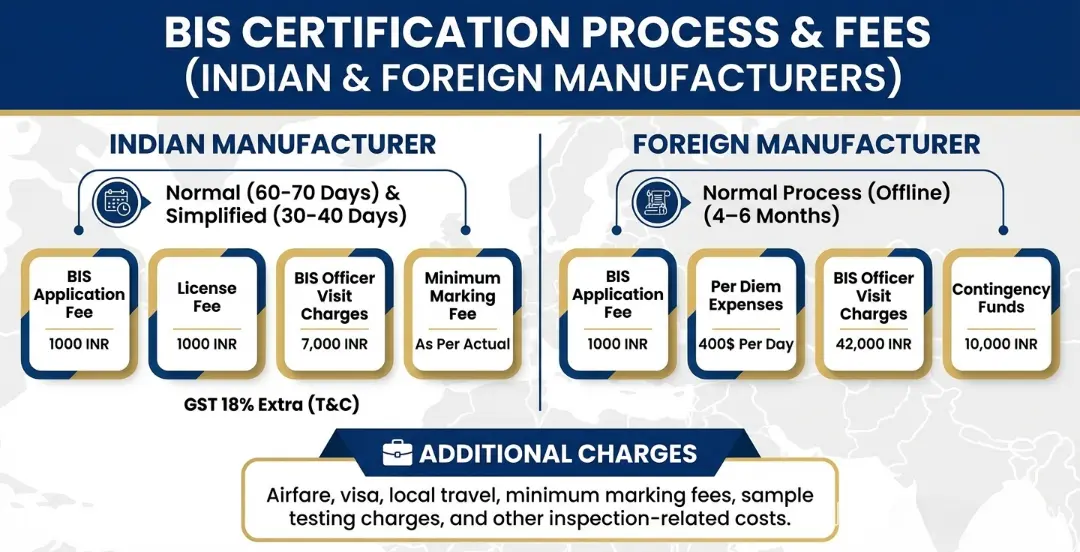
Total timeline: 8-14 weeks (Indian manufacturers) · 12-18 weeks (foreign manufacturers, FMCS) due to overseas audit scheduling. BIS ISI Mark licences are now granted for up to 5 years under the BIS Conformity Assessment Amendment Regulations, 2026.
Documents Required for Bearing BIS Certification
- BIS application form (Manakonline)
- Factory registration / incorporation proof
- Udyam Registration (MSME fee discount)
- Manufacturing process flow chart
- List of manufacturing & CNC machinery
- In-house testing equipment list
- Raw material & steel grade details
- Product range & size designations
- Trademark / brand registration
- Factory layout plan
- BIS-recognized lab test report
- AIR appointment letter (foreign mfr. only)
BIS Certification Cost for Bearings - Quick Reference
Cost Components - ISI Mark for Bearings
Exact fees depend on bearing type, number of IS standards, enterprise size, and whether the factory is domestic or overseas. Contact Standphill India for a transparent, model-specific quotation - response within 24 hours.
Also Read
Authorized Indian Representative (AIR) for BIS Certification - Foreign Manufacturers BIS FMCS Certification for Foreign Manufacturers - Complete Guide BIS ISI Mark Certification for Domestic Manufacturers BIS Corrigendum 2026 - 5-Year Licence Validity Update Quality Control Orders (QCOs) - Complete India List & StatusWhy Bearing Manufacturers Worldwide Choose Standphill India
Standphill India is a global BIS consultancy - and the Bearings QCO 2025 is one of the most international in scope, covering bearing types exported to India from China, Japan, Germany, the USA, South Korea, Italy, Sweden, and beyond. Here is what you get when you work with us:
- All 12 bearing standards covered - from tapered roller and deep groove ball bearings to needle bearings, thrust washers, and sintered bushings. We know every IS standard.
- Exact deadline calculation - we determine your specific compliance deadline (6/9/12 months) based on your enterprise classification and gazette date, so you know exactly how much runway you have.
- Multi-licence project management - manufacturing multiple bearing types? We run all applications as one coordinated project, with synchronized factory audit scheduling and shared document packages where possible.
- Factory audit preparation - before any BIS inspector visits, we prepare your plant: what machinery must be demonstrated, what in-house testing equipment must be available and calibrated, what quality records must be ready.
- Full FMCS & AIR service for overseas factories - complete Foreign Manufacturers Certification Scheme support for bearing producers in China, Japan, Germany, South Korea, Italy, Sweden, the USA, Taiwan, Thailand, and beyond.
- MSME discount optimization - we verify your Udyam classification and apply the maximum allowed marking fee concession from Day 1 of your application.
- Post-certification compliance - 5-year licence tracking, annual fee reminders, production statement submissions, and surveillance audit coordination. You focus on manufacturing; we handle the compliance calendar.
- Transparent pricing, no surprises - written cost estimate per bearing type and IS standard before any work begins.
Get Your Bearing ISI Mark Before the Deadline
Tell us your bearing types, enterprise size, and factory location - we'll confirm your exact IS standards, deadline, and cost estimate within 24 hours. Indian and overseas manufacturers equally welcome.
Get Free Quotation +91-9667674225 WhatsApp NowFrequently Asked Questions - BIS Certification for Bearings
Start Your Bearing BIS Certification Today
6/9/12-month deadline is counting. 8-14 week process. Don't delay.
Get Your Bearing ISI Mark - Free Consultation
Tell us your bearing type, enterprise size, and factory country - we'll confirm your IS standard, exact deadline & cost within 24 hours.
★ Why Standphill India?
- 20+ Years of BIS Certification Experience
- 10,000+ Certifications Delivered Globally
- Dedicated Teams for CRS, FMCS & ISI Mark
- End-to-End Documentation & Filing Support
- Fast Response & Practical Compliance Guidance
- Support for Indian & Foreign Manufacturers
Get Free Call Back
Our Services
- BIS (ISI Mark) for Foreign Manufacturers
- Domestic BIS (ISI Mark) Certification
- BIS Certificate of Conformity (CoC)
- BIS Hallmarking
- BIS Licence for Toys
- ECO Mark Certification
- TAC Approval for Automobile
- Drug Licence
- Peso Certification
- BIS (CRS) Registration
- WPC-ETA Approval
- BEE Certification
- E-Waste Management (EPR)
- EPR for Plastic Waste
- EPR for Battery Waste
- CE Certification
- UL Certification
- ROHS Licence
- Standardization Division
- Import / Export Licence
- FSSAI Certification
- ISO Registration
- Trademark Registration
- Make in India Support
- AG-Mark Licence
- Third Party Monitoring
Client Testimonials
Their team was very knowledgeable and helped us every step of the way. Standphill India is the best BIS certification consultants for any type of BIS certification.

Chintan Shah (AGM)
Sudeep Nutrition P.Ltd




Featured Guide
Complete BIS CRS certification guide for electronic products in India — free to read.
Read CRS Certification Guide📞 Contact Standphill India
+91-9667674225 info@standphillindia.in WhatsApp Now Greater Noida West, UPGet Expert BIS Certification Support for Your Business
Connect with Standphill India for complete support with BIS certification, CRS registration, WPC approval, FMCS compliance, and related regulatory services. Our team helps businesses with documentation, testing coordination, application support, and end-to-end compliance guidance.
Request Free Consultation
Share your requirement and our team will contact you shortly.